
Sagging Or Bulging
A ceiling that sags is holding water weight it was never designed for. Collapse can happen suddenly — clear the area now.
Emergency Line — Open Now
A sagging ceiling is a structural warning — waterlogged drywall is heavy, and it fails suddenly and completely. If your ceiling is bulging, dripping, or spreading fast, standard ceiling diagnosis is for later; right now is for action. Call — 24/7, 30–45 minute arrival.
24/7 Emergency Service
A bulging ceiling can collapse without further warning. Clear the area below, do not touch the bulge, and call now.
Call (617) 380-4912 NowWhen To Call Now
Ceiling leaks become emergencies when the ceiling's integrity — or the rooms below — are at risk. Not sure it qualifies? See our emergency overview for the full list.
Warning Signs
Ceilings fail from the inside out — by the time you see it, the structure is already loaded.
A ceiling that sags is holding water weight it was never designed for. Collapse can happen suddenly — clear the area now.
Water through electrical fixtures is a dual emergency: structural and electrical. Switch off the circuit and keep clear.
A stain that grows while you watch means a pressurized source above, not a slow drip. The volume is the warning.
Paint cracking and plaster flaking around a wet area signal advanced saturation. The ceiling's structure is compromised.
Before We Arrive
Clear, catch, power off, hands off — the ceiling emergency drill.
Move people, pets, furniture, and valuables from under the affected ceiling. Collapse gives no countdown.
Place containers under drips without standing directly beneath the worst sagging. Protect flooring from the spread.
If water nears light fixtures or fans, turn off that circuit at the breaker. Wet ceiling electrics are a shock risk.
Puncturing a sagging ceiling releases the water load suddenly — flooding the room and risking injury from falling material.
Safety Guidance
Gravity makes ceiling emergencies uniquely dangerous — respect the load.
Waterlogged drywall and plaster are far heavier than they look. Treat every sagging ceiling as a collapse risk until assessed.
Ceiling fixtures with water ingress must be treated as live hazards. Breaker off, area clear, professional assessment first.
If the source is an upstairs fixture, shut off that fixture's valve or the main. Stopping the feed is stopping the load.
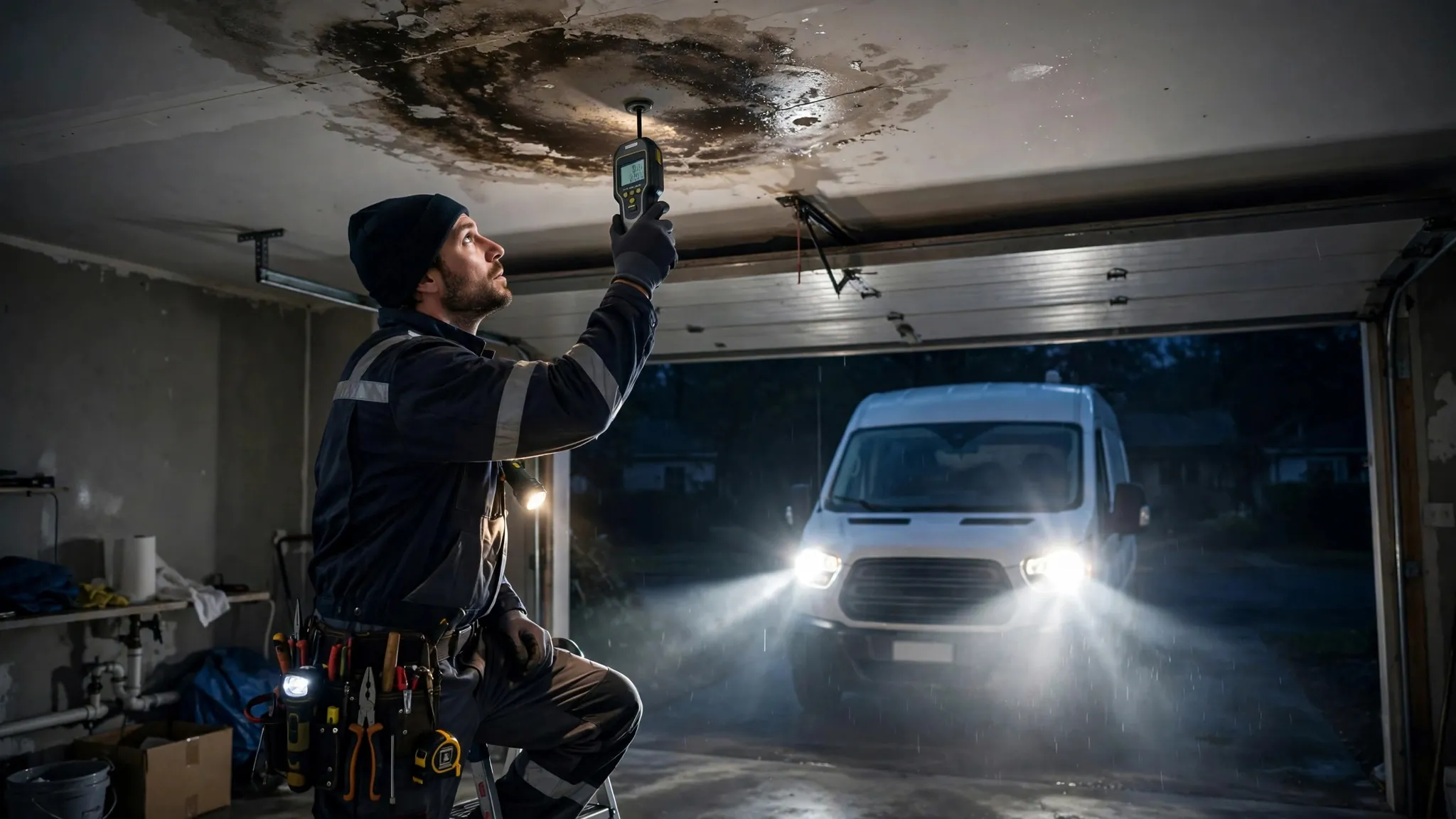
A ceiling emergency is a structural emergency wearing a plumbing disguise. Drywall and plaster absorb water until their fasteners and structure can no longer carry the load — and the failure mode is sudden, dropping saturated material without warning. Meanwhile the source above — a burst supply line, a failed water heater, an overflowing fixture — continues adding weight. Our emergency protocol addresses both ends: thermal imaging traces the source through the ceiling from below, we identify the feed above, and the water is stopped before the ceiling's load grows further. The ceiling itself is then assessed for safe remediation — because a stopped leak under a compromised ceiling is only half resolved. The weight of a saturated 4x8 drywall sheet can exceed 100 pounds — multiply that across a wet ceiling and the collapse risk becomes viscerally clear.
Our Process
Stop the water, assess the structure, document everything — in that order. Our has handled Chelsea emergencies for thirteen years.
Describe the ceiling: sagging, dripping, spreading, electrical involvement. We give immediate safety guidance and dispatch with 30–45 minute arrival.
On arrival we thermally scan the ceiling to map moisture extent and trace the source — usually a failed line or fixture in the space above.
We shut off or isolate the feeding line or fixture, halting the water load on the compromised ceiling.
Ceiling condition assessed for safety, source marked, everything photographed and written up for remediation and insurance.
With the source stopped, the ceiling needs professional assessment before anyone works beneath it. Saturated sections typically require removal — our moisture map defines the boundary so remediation is precise, not exploratory. The plumbing repair at the source is usually straightforward once located. Keep our ; insurers expect documentation of both the source and the structural impact for ceiling-collapse claims.
Standard Service
For slow ceiling stains without sagging or active dripping, our standard ceiling leak service provides the same precise source tracing.
A ceiling stain that grows, drips, or darkens needs fast answers. We trace ceiling leaks to the true source — roof, pipe, or fixture — before damage spreads.
Related Services
Ceiling water comes from above — these are the usual sources.
Damp insulation or drips in the attic after rain or snow need a fast trace. We find whether the source is roofing, flashing, or a pipe — then map it.
Damp patches, bubbling paint, or a musty smell can hide a wall leak. We pinpoint the exact pipe or entry point behind drywall so repairs stay small and surgical.
Our core specialty: acoustic sensors, thermal imaging, and tracer gas find hidden leaks behind walls, under floors, and underground — accurately, non-invasively, in a single visit.
Service Areas
Emergency ceiling leak response across all eight Chelsea neighborhoods — 24/7, 30–45 minute arrival, ZIP 02150. See all emergency services on the overview hub.
FAQs
Urgent answers when the ceiling is failing. For non-urgent questions, see our standard service page.
Possibly, and without warning. Waterlogged drywall is extremely heavy. Clear the area below immediately, do not touch the sagging section, and call (617) 380-4912 now.
Turn off that circuit at the breaker immediately and keep clear. Water and ceiling electrics are a shock risk. Then call us — this is a dual emergency.
No. Puncturing a loaded ceiling releases water suddenly, floods the room, and can bring down material on you. Let professionals assess and control the release.
Thermal imaging maps the moisture path through the ceiling surface, tracing it back to the failed line or fixture above — no exploratory demolition needed.
Only the saturated sections — our moisture map defines exactly which areas are compromised, so remediation is surgical rather than wholesale.
There is no reliable timeline — saturation failures happen suddenly, without additional warning. A ceiling that has held for hours can fail in the next minute as fasteners give way. That unpredictability is exactly why sagging ceilings are tonight calls, not morning calls. Clear the area and let us assess it.
Sagging ceilings collapse without warning. Clear the area and call (617) 380-4912 — we arrive in 30–45 minutes, 24/7.