
Inches Lost Overnight
Normal evaporation is fractions of an inch. Inches overnight is a structural or plumbing failure discharging continuously.
Emergency Line — Open Now
A pool dropping inches overnight is not evaporation — it is a structural or plumbing failure that threatens equipment, erodes surrounding soil, and wastes thousands of gallons. Standard pool leak detection handles slow losses; rapid draining needs urgent diagnosis. Call — 24/7, 30–45 minute arrival.
24/7 Emergency Service
A rapidly draining pool threatens pumps, soil, and structure. Shut the pump off if the level drops near the skimmer — then call.
Call (617) 380-4912 NowWhen To Call Now
Pool leaks become emergencies when water loss is rapid or equipment is at risk. Not sure it qualifies? See our emergency overview for the full list.
Warning Signs
Pools fail fast and expensively — rapid loss is always urgent.
Normal evaporation is fractions of an inch. Inches overnight is a structural or plumbing failure discharging continuously.
A pump starved of water overheats and destroys its seals in hours. Shut it off if the level nears the skimmer — a dead pump doubles the bill.
Water escaping under the deck erodes base material. Settlement cracks are the surface evidence of subsurface washout.
Burst pool plumbing at the pad floods pumps, heaters, and electrics. De-energize the pad and keep clear of the water.
Before We Arrive
Equipment off, level marked, people out — the pool triage.
If water nears the skimmer mouth, kill the pump at the breaker. A dry-running pump destroys itself in hours — protect the equipment first.
Tape-mark the level and note the time. The drop rate tells us the leak's scale and helps distinguish plumbing from structural failure.
If the equipment pad is flooding, switch off pool equipment breakers. Water plus pool electrics is a serious hazard.
Rapid water loss can indicate structural issues. No swimming until the leak is diagnosed — safety first.
Safety Guidance
Pools combine water, electricity, and structure — respect all three in an emergency.
Pumps, heaters, and lighting with water intrusion are shock hazards. Breakers off before approaching a flooded equipment pad.
Major leaks can undermine the pool shell and deck. Keep off visibly settled deck areas until assessed.
Rapid water loss and refilling destabilize chemistry. Do not swim until the leak is fixed and chemistry rebalanced.
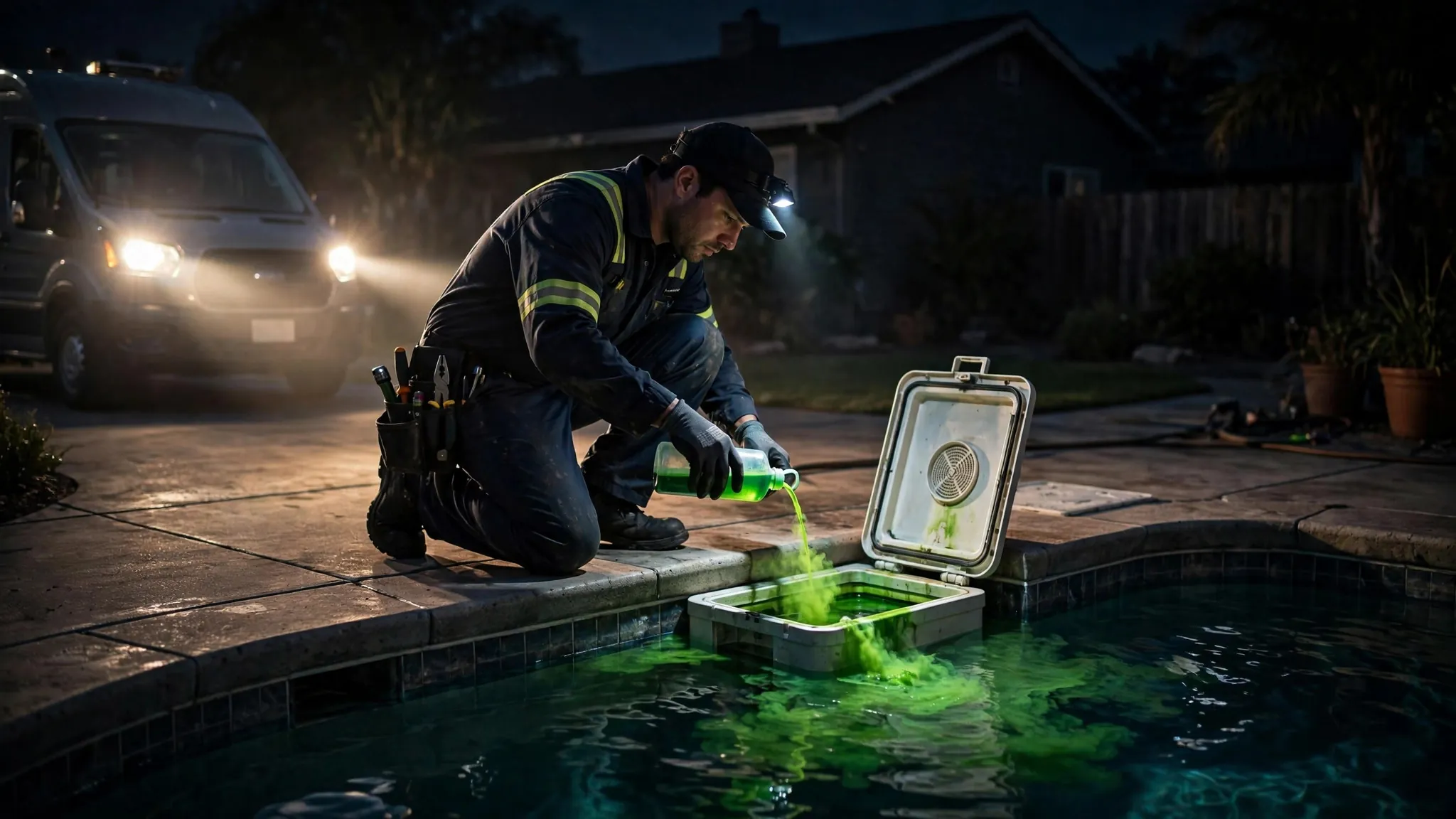
A pool emergency is a race against three clocks: the water level (equipment damage when the pump starves), the soil (erosion under decks and shells), and the water bill (thousands of gallons). Structural leaks — shell cracks, failed fittings, separated skimmers — and plumbing leaks — burst underground lines, failed valves — both discharge continuously, and telling them apart determines the entire repair. Our emergency protocol uses dye testing for structural suspects and acoustic methods for plumbing runs, isolating the failure type on arrival so the response targets the right system. The goal tonight: stop the loss, protect the equipment, and define the repair — not a full diagnosis of every aging fitting. Autofill systems can mask a pool leak for weeks by silently replacing lost water — if your autofill runs constantly, the leak was already an emergency.
Our Process
Secure equipment, isolate the failure type, define the repair — tonight's scope. Our has handled Chelsea emergencies for thirteen years.
Describe the loss rate, equipment status, and any visible symptoms. We give pump-shutdown guidance and dispatch with 30–45 minute arrival.
On arrival we verify pumps and electrics are safe — equipment protection comes before leak hunting in pool emergencies.
Bucket test logic, dye testing at suspects, and acoustic checks on plumbing runs isolate structural vs. plumbing failure.
The failure is defined, the water loss controlled as far as possible tonight, and everything documented for the repair plan.
With the failure type identified and equipment protected, the repair plan takes shape: structural repairs for shell and fitting failures, plumbing repairs for broken underground lines. Some pool leaks can be stabilized tonight (valve isolations, for example); structural repairs are planned work. Our standard pool service provides the complete diagnostic workup — pressure testing every line, dye testing every suspect — for the full repair scope and for preventing the next emergency.
Standard Service
For slow, mysterious pool water loss without urgency, our standard pool leak service provides the complete diagnostic workup.
Losing more than a quarter inch of pool water a day? We test, isolate, and pinpoint pool shell and plumbing leaks so you stop refilling and start swimming.
Related Services
Pool emergencies connect to these — each has its own emergency page.
A spa that needs constant refilling has a leak at a jet, seal, heater, or shell. We pinpoint hot tub leaks fast — including equipment-pad plumbing.
Weak sprinkler zones, geysers, or a soggy lawn waste water and money. We pinpoint irrigation line and valve leaks so repairs target the exact spot.
Our core specialty: acoustic sensors, thermal imaging, and tracer gas find hidden leaks behind walls, under floors, and underground — accurately, non-invasively, in a single visit.
Service Areas
Emergency pool leak response across all eight Chelsea neighborhoods — 24/7, 30–45 minute arrival, ZIP 02150. See all emergency services on the overview hub.
FAQs
Urgent answers when the pool is draining. For non-urgent questions, see our standard service page.
Very — that rate indicates a structural or plumbing failure, not evaporation. Shut the pump off if the level nears the skimmer and call (617) 380-4912 now.
Only to protect equipment (keeping the skimmer submerged) — and only while diagnosing. Continuous refilling without diagnosis wastes water and hides the loss rate.
We can isolate the failure type and secure the situation at night. Full dye-test diagnostics are sometimes better in daylight; we stabilize tonight and complete the workup promptly.
No — not until the leak is diagnosed. Rapid loss can indicate structural issues, and chemistry will be unstable. Keep everyone out.
A pump run dry can destroy its seals in hours — which is why shutting it off at low water is the critical first move. Tell us the pump's status when you call.
We stabilize the situation tonight — equipment protected, water loss controlled as far as possible, failure type defined. The complete repair is planned work, but tonight stops the hemorrhaging and prevents the secondary damage (dead pumps, eroded soil) that turns a leak into a reconstruction. Stabilization is the emergency; restoration follows.
Rapid pool loss threatens equipment and structure. We arrive in 30–45 minutes, 24/7 — call (617) 380-4912.