
Spreading Warm Spots
A warm patch that grows across the floor means the break is widening. Hot water erodes soil fastest — call before the slab settles.
Emergency Line — Open Now
A burst hot-water line under your slab can pump hundreds of gallons into the ground beneath your home every hour — undermining the foundation while the meter spins. Our standard slab service handles the diagnosis; this page is for when it cannot wait. Call now — we arrive in 30–45 minutes, 24/7.
24/7 Emergency Service
A slab leak emergency means pressurized water escaping under your foundation right now. Shut off the main if you can, then call — we will talk you through it and dispatch immediately.
Call (617) 380-4912 NowWhen To Call Now
Slab leaks become emergencies when the water loss is sudden, large, or threatening the structure. If any of these match, call now. Not sure it qualifies? See our emergency overview for the full list.
Warning Signs
These signs mean an active, pressurized break — not a slow seep. Every hour counts.
A warm patch that grows across the floor means the break is widening. Hot water erodes soil fastest — call before the slab settles.
Hearing water under concrete with everything off is a pressurized break, not a drip. The longer it runs, the more foundation support washes away.
Cracks appearing or widening in slab floors signal soil erosion below. This is structural territory — stop the water first.
A water heater that never shuts off is feeding a break. You are paying to heat water that pours straight into the ground.
Before We Arrive
Four actions that protect your foundation while our van is rolling. Then read the full guidance when things are calm.
Turn the main shutoff clockwise until it stops. This halts the pressurized flow immediately — the single most effective thing you can do.
With the main off, switch the heater to pilot or off. A heater firing against a closed system with a break can overheat.
Walk barefoot and note where floors feel warm. Mark the edges with tape — this map helps us triangulate the break faster on arrival.
Cracks, damp spots, meter readings — photograph it all with timestamps. Insurers ask for this documentation first.
Safety Guidance
Slab emergencies are structural as well as plumbing — treat them with that seriousness.
Water under slabs can reach electrical conduits. If outlets near damp areas feel warm or trip breakers, keep clear and tell us on arrival.
Sudden slab cracking can indicate voids forming below. Keep people and heavy furniture away from visibly shifting areas.
Open windows where flooring is damp. Trapped moisture under flooring breeds mold within days — airflow slows it until repairs happen.
A slab leak emergency is a race between water volume and foundation stability. Pressurized hot-water lines break most often — heat and chemistry thin copper from the inside — and once split, they discharge continuously at full pressure. The water follows the path of least resistance: along the pipe trench, under the slab, eroding the compacted soil your foundation rests on. What starts as a warm floor spot becomes, over days, a void — and voids become settlement, cracking, and structural repair bills that dwarf the plumbing fix. That is why slab leak detection exists as an emergency discipline: find the exact break fast, stop the loss, and limit the emergency to a plumbing repair instead of a foundation project. Hot-water slab breaks are the most destructive because heat accelerates soil erosion — a cold-water break buys more time, but neither should wait.
Our Process
Built for speed without sacrificing precision — a wrong mark under a slab is an expensive mistake. Our has handled Chelsea emergencies for thirteen years.
Describe the symptoms — warm spots, sounds, meter behavior. We give immediate shutoff guidance and dispatch with 30–45 minute arrival, 24/7.
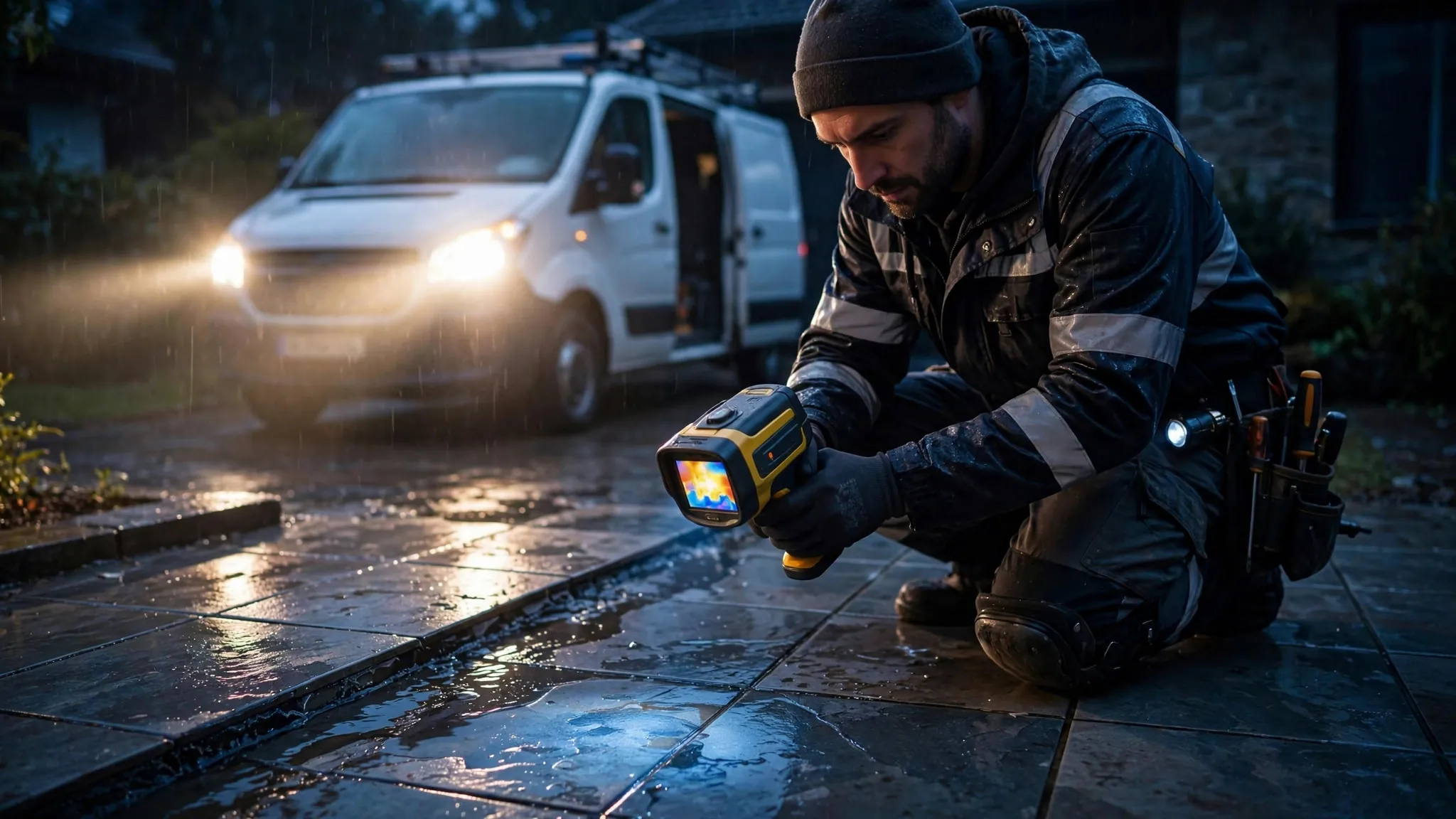
On arrival we run thermal imaging across the slab to map the hot-water anomaly, then acoustic listening to confirm the break's exact signature.
The break point is marked on the floor with isolation options identified — which valve stops it, what stays running, what the repair involves.
We help stop the active loss, then document everything: location, photos, and next-step repair options for your plumber or insurer.
Once the break is located and the water stopped, the emergency is over — what remains is a planned repair. Most slab breaks are fixed by a targeted spot repair through a small slab opening, or by rerouting the line overhead. Our written report gives your plumber the exact location and our for any follow-up questions. If the line is a repeat offender, ask about epoxy lining — a trenchless option that renews the pipe without breaking the slab at all.
Standard Service
When the situation is stable, our standard slab leak service provides the full diagnostic workup — method comparisons, prevention guidance, and detailed FAQs.
Warm spots on floors, rising water bills, or the sound of running water under concrete all point to a slab leak. We trace it precisely so repairs open the smallest area.
Related Services
Slab emergencies overlap with these urgent services — tap through if your situation matches better.
Our core specialty: acoustic sensors, thermal imaging, and tracer gas find hidden leaks behind walls, under floors, and underground — accurately, non-invasively, in a single visit.
Soggy lawn, sinking soil, or water surfacing where it should not can mean a buried pipe leak. Ground microphones and tracer gas locate it without tearing up your yard.
Low pressure, soggy ground between the street and your home, or a spinning meter can signal a service line leak. We locate it precisely with no blind digging.
Service Areas
Emergency slab leak response across all eight Chelsea neighborhoods — 24/7, 30–45 minute arrival, ZIP 02150. See all emergency services on the overview hub.
FAQs
Urgent slab-leak questions, answered directly. For non-urgent questions, see our standard service page.
Most emergency slab locations are completed within the visit. Thermal imaging maps the anomaly in minutes; acoustic confirmation follows. We arrive in 30–45 minutes, 24/7.
Yes, if you safely can — it stops the loss immediately. If you cannot find or turn the valve, call us; we will talk you through it or handle it on arrival.
No. Emergency detection is non-invasive — we locate and mark the break. Any slab opening happens later, as a planned repair, at the marked spot only.
A pressurized break under the slab is — it erodes foundation soil continuously. A slow seep can wait for a standard visit; a burst, spreading warm spots, or running water sounds cannot.
Call (617) 380-4912 for current pricing — it depends on the situation. What we can promise: no exploratory demolition, an exact location, and a written report.
A slow seep with no spreading can wait for a standard visit — but spreading warm spots, running water sounds, or new cracks cannot wait. The difference is whether the break is pressurized and growing. When in doubt, call (617) 380-4912; we will tell you honestly whether it can wait, at no cost for the advice.
Pressurized water under your foundation cannot wait. We arrive in 30–45 minutes, 24/7 — call (617) 380-4912.