
Rising Standing Water
Water that rises is water still coming. The source is active — every hour adds structural load to joists and piers.
Emergency Line — Open Now
Water pooling under your house attacks the structure from below — saturating joists, undermining piers, and filling the air with mold. When crawlspace water is active or rising, standard crawlspace investigation is for later. Call now — 24/7, 30–45 minute arrival.
24/7 Emergency Service
Water under the house is a structural emergency in slow motion — faster when it is rising. Call now.
Call (617) 380-4912 NowWhen To Call Now
Crawlspace water becomes an emergency when it is active, rising, or threatening the structure. Not sure it qualifies? See our emergency overview for the full list.
Warning Signs
What happens under the house does not stay under the house — it comes up through the floors.
Water that rises is water still coming. The source is active — every hour adds structural load to joists and piers.
Bouncy or sagging floors mean joists are saturated. Keep heavy furniture and foot traffic off affected areas.
Seeing or hearing water discharge from crawlspace pipes is a burst, not a seep — shut the main and call.
The combination suggests a drain-line failure below the house — a health hazard as well as a structural one.
Before We Arrive
Observe from safety, shut off if it is supply water, protect the structure above.
Active pipe discharge means a pressurized break — the main shutoff stops it. Sewage or groundwater intrusion will not respond to shutoffs; note which you see.
Flooded crawlspaces hide electrical hazards, sewage, and structural risks. Observe from the access point — we are equipped to enter safely.
Clear water suggests supply lines; odorous or discolored water suggests drains or groundwater. The distinction directs our whole response.
Move heavy items off sagging areas and limit foot traffic. Saturated joists are weaker than they look.
Safety Guidance
The crawlspace is the most hazardous part of the house in a water emergency — stay out of it.
Standing water below a house can conceal live wiring, sewage, and collapsed supports. Professional entry only — no exceptions.
Active crawlspace moisture aerosolizes mold into living spaces. Limit time in rooms above heavily affected areas, especially for sensitive individuals.
Saturated joists and piers lose load capacity. Treat sagging floors as structural warnings until professionally assessed.
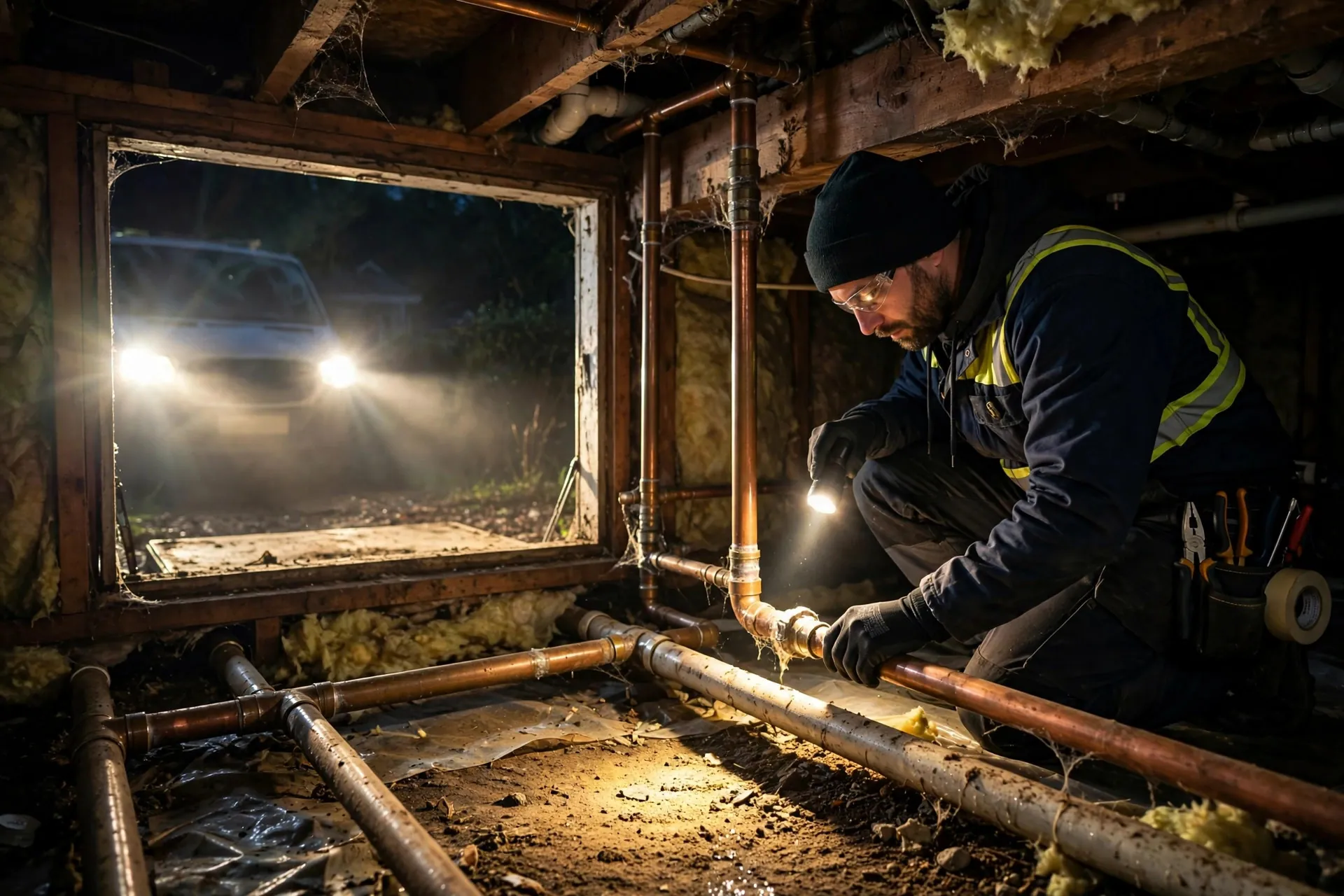
A crawlspace emergency is two emergencies stacked: the water source and the structure it is destroying. Supply-line bursts flood the space with clean pressurized water; drain failures fill it with contamination; groundwater intrusion signals drainage failure. All three saturate joists, subflooring, and insulation — and all three get worse by the hour. Our emergency protocol starts with safe assessment: equipped crawlspace entry with proper lighting and protection, source identification (supply vs. drain vs. groundwater), immediate water stoppage where possible, and a structural-moisture map that tells remediation exactly what is wet. The emergency ends when the water stops; the dry-out plan begins the same night. Vapor barriers, when present, can actually hide the water's extent by channeling it — we check both above and below the barrier during assessment.
Our Process
Safe entry, source control, structural mapping — the under-house protocol. Our has handled Chelsea emergencies for thirteen years.
Describe what you observe: water level, odors, floor symptoms, sounds. We assess entry safety and dispatch with 30–45 minute arrival.
On arrival we enter equipped — lighting, protection, electrical awareness — and assess water source, depth, and structural exposure.
Supply breaks are shut off; drain failures documented for repair; groundwater intrusion mapped for drainage solutions.
Moisture mapping of joists and subfloor, photos, and a written report — the remediation roadmap, delivered tonight.
With the source controlled, the crawlspace needs dry-out: standing water extracted, wet insulation removed, and structural drying begun. Our moisture map guides remediation precisely — which joists are wet, how far the saturation extends. If the source was a supply break, the plumbing repair is usually a single section at our marked point. For groundwater intrusion, the conversation shifts to drainage. Our standard crawlspace service covers the full follow-up, from verification to prevention planning.
Standard Service
For damp (not flooded) crawlspaces and musty odors without active water, our standard crawlspace service investigates thoroughly.
Musty smells, damp subfloors, or standing water under your home point to a crawlspace leak. We find it without tearing up floors — moisture mapped, source found.
Related Services
Under-house water connects to these — each has its own emergency page.
Warm spots on floors, rising water bills, or the sound of running water under concrete all point to a slab leak. We trace it precisely so repairs open the smallest area.
Our core specialty: acoustic sensors, thermal imaging, and tracer gas find hidden leaks behind walls, under floors, and underground — accurately, non-invasively, in a single visit.
Damp insulation or drips in the attic after rain or snow need a fast trace. We find whether the source is roofing, flashing, or a pipe — then map it.
Service Areas
Emergency crawlspace response across all eight Chelsea neighborhoods — 24/7, 30–45 minute arrival, ZIP 02150. See all emergency services on the overview hub.
FAQs
Urgent answers when the water is under the house. For non-urgent questions, see our standard service page.
If it is rising or actively flowing, very — structural saturation compounds hourly. Do not enter the crawlspace; call (617) 380-4912 now, 24/7.
No — not during an active water emergency. Flooded crawlspaces hide electrical hazards, sewage, and structural risks. We enter with proper equipment and training.
Color, odor, and source behavior — plus testing where needed. The distinction determines whether we shut a valve or document a drain failure for repair.
It depends on saturation extent and duration — which is exactly why speed matters. Our moisture map assesses joist and subfloor condition for the remediation plan.
Dry-out begins: extraction, wet material removal, structural drying guided by our moisture map. We document everything for your remediation contractor and insurer.
Days to weeks depending on saturation depth and extent — which is exactly why our moisture map matters so much. Targeted drying of mapped wet areas beats whole-space guesswork by a wide margin. The map we deliver tonight becomes the remediation contractor's work plan tomorrow, with no wasted effort on dry zones.
Rising crawlspace water attacks your structure hourly. We arrive in 30–45 minutes, 24/7 — call (617) 380-4912.