
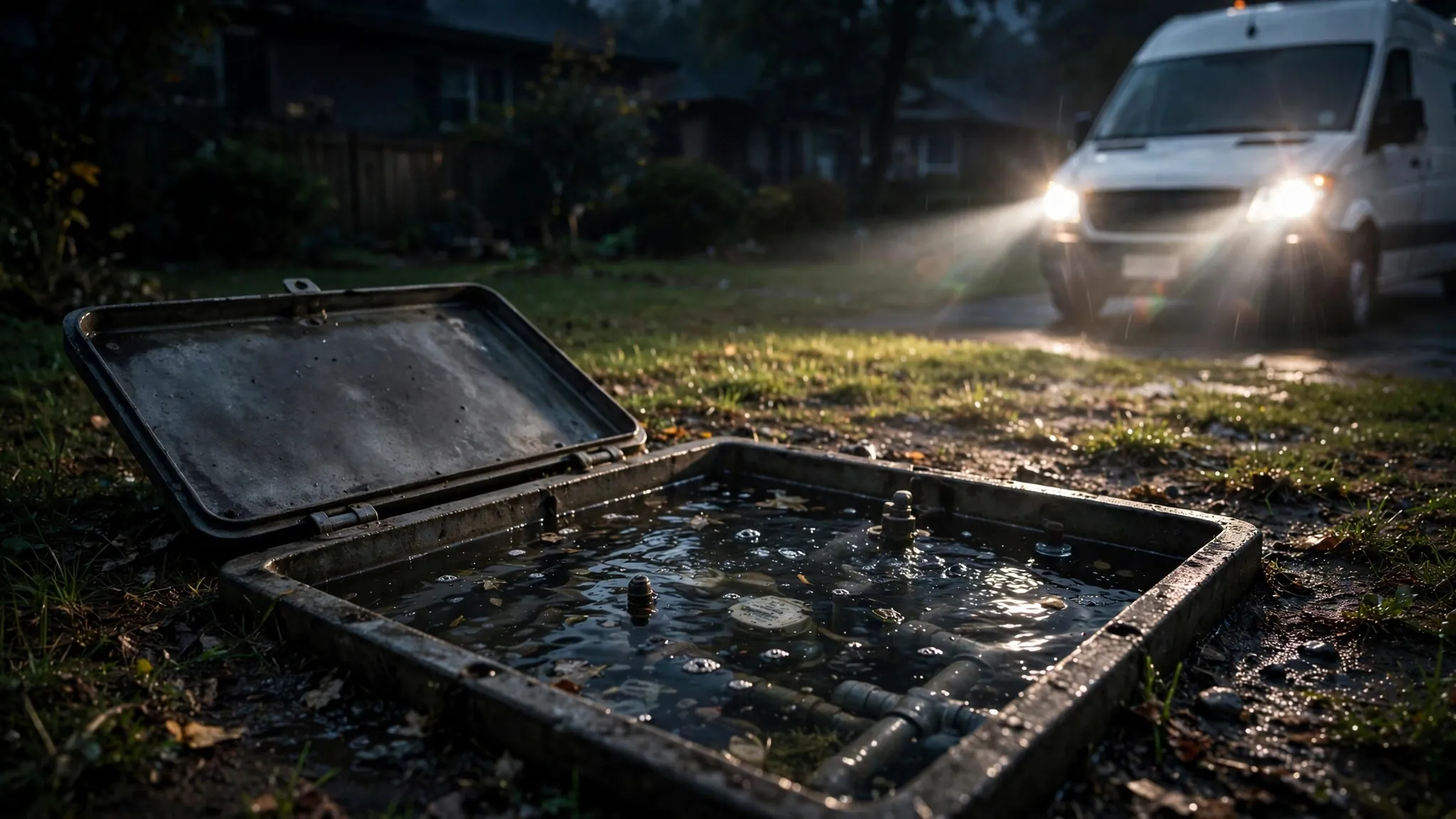
Actively Flowing Water
Flow — not dampness — means a pressurized break at or near the box. The source is close; the volume is the emergency.
Emergency Line — Open Now
A meter box full of actively flowing water means a break is discharging right there — and whether it is the city's side or yours determines who fixes it and who pays. Standard meter-box diagnosis handles the merely damp; gushing or flooding needs tonight. Call — 24/7, 30–45 minute arrival.
24/7 Emergency Service
A gushing meter box is a break at your property's front door. Note which side the water comes from — then call.
Call (617) 380-4912 NowWhen To Call Now
Meter-box situations become emergencies when water is actively flowing or the ground is compromised. Not sure it qualifies? See our emergency overview for the full list.
Warning Signs
The meter box is the property's water gateway — when it floods, the break is at the gate.
Flow — not dampness — means a pressurized break at or near the box. The source is close; the volume is the emergency.
A box that cannot contain the inflow is fed by a major break. The water has to go somewhere — usually across your yard.
Soil washing away around the box undermines it and anything nearby. Keep off the soft ground.
No indoor water plus a flooding box points to a service-side break — potentially the utility's responsibility. Document everything.
Before We Arrive
Observe the flow direction, document everything, stay out of the water.
Look carefully: is water entering from the street side or the house side of the meter? The answer determines responsibility — note it and photograph it.
Meter boxes can hide sharp edges, insects, and electrical conduits. Observe from above; do not grope blindly in flooded boxes.
Water level, flow direction, erosion, the meter reading — timestamped photos are your evidence for the utility or insurer.
Saturated soil around the box can be unstable. Rope off or mark the area until assessed.
Safety Guidance
Small box, big hazards — observe, document, and let professionals open it.
Flooded meter boxes conceal sharp metal, broken lids, and sometimes wiring. Never reach in blindly — observation only.
Keep people, pets, and vehicles off ground softened by meter-box flooding. Voids form fastest near concentrated flow.
If the break is on the service side, the water utility needs immediate notification — we help you document and report on arrival.
A meter-box emergency is a location emergency with a legal dimension. The box sits at the boundary between utility infrastructure and private plumbing, and an active break there could belong to either side — with very different consequences for who repairs and who pays. Our emergency protocol answers both questions at once: is the leak on the service side, the house side, or the box itself — determined by flow observation, pressure behavior, and meter diagnostics — while controlling the active discharge. Getting the "whose" right tonight prevents the most expensive meter-box mistake: paying for the city's pipe, or waiting on the city for yours. Corroded curb stops and meter setters are frequent culprits — the box concentrates every weakness of the service connection in one place.
Our Process
Whose break, where exactly, controlled tonight — the meter-box protocol. Our has handled Chelsea emergencies for thirteen years.
Describe the box: flow rate, direction, erosion, house water status. We assess the responsibility question immediately and dispatch with 30–45 minute arrival.
On arrival we determine the water's origin — service side, house side, box seals, or groundwater — with the box opened safely.
We identify which side of the responsibility line the break sits on, so the right party — you or the utility — takes the repair.
The flow is controlled as far as possible, and everything is photographed and written up — the evidence package for repair and reporting.
With the source side identified, the path is clear: house-side breaks go to your plumber with our marked location; service-side breaks get reported to the water utility with our documentation. Either way, the emergency phase — active uncontrolled flow — ends tonight. For the future, keep the box accessible and check it seasonally; our standard meter-box service handles the non-urgent investigations that prevent the next emergency.
Standard Service
For damp (not flowing) meter boxes and slow seeps, our standard meter-box service diagnoses methodically.
Water pooling in the meter box or a soggy strip near the street means a leak between the meter and your home. We find it without digging up the yard.
Related Services
Meter-box emergencies connect to these — each has its own emergency page.
A spinning meter with everything off confirms water is escaping somewhere. Our meter checks isolate the loss fast, then pinpoint the exact source.
Low pressure, soggy ground between the street and your home, or a spinning meter can signal a service line leak. We locate it precisely with no blind digging.
Water bill suddenly high with no visible leak? We check the meter, the service line, and your home to find the hidden loss — then show you exactly where it is.
Service Areas
Emergency meter-box response across all eight Chelsea neighborhoods — 24/7, 30–45 minute arrival, ZIP 02150. See all emergency services on the overview hub.
FAQs
Urgent answers at the property's water gateway. For non-urgent questions, see our standard service page.
Observe which side the water comes from (street side or house side), photograph it, keep out of the water, and call (617) 380-4912. We arrive in 30–45 minutes, 24/7.
Flow direction, pressure behavior, and meter diagnostics reveal whether the break is on the service side, house side, or the box itself. We document the determination in writing.
If the break is on the service side — yes, immediately. We help you document the location and condition for that report on arrival.
For observation, carefully — but never reach blindly into a flooded box. Sharp edges, insects, and wiring hide in the water. We open boxes with proper tools.
Then there is no pipe emergency — but the box still needs drainage attention. Our diagnosis distinguishes groundwater from pressurized breaks conclusively.
Yes — intermittent breaks resume, often worse than before. Pressure fluctuations, temperature changes, and soil movement all restart paused leaks. A break that pauses is still a break, and locating it while the evidence (wet soil, flow marks) is fresh is far easier than after everything dries. Do not let a pause become a surprise.
An active meter-box break needs tonight's diagnosis. We arrive in 30–45 minutes, 24/7 — call (617) 380-4912.