
Unexplained Gushing
Water surfacing with no fixture running means a pressurized underground break. The flow rate indicates the severity.
Emergency Line — Open Now
A burst underground pipe does not announce itself politely — it floods, erodes, and undermines, often all three at once. Standard underground pipe surveys handle suspected slow leaks; gushing or collapsing ground needs tonight. Call — 24/7, 30–45 minute arrival.
24/7 Emergency Service
A burst buried pipe erodes soil by the hour. Keep off soft ground and call now.
Call (617) 380-4912 NowWhen To Call Now
Underground pipe failures become emergencies when water volume is high or structures are threatened. Not sure it qualifies? See our emergency overview for the full list.
Warning Signs
Buried pipe failures attack foundations and surfaces from below — the visible signs are late warnings.
Water surfacing with no fixture running means a pressurized underground break. The flow rate indicates the severity.
Ground that sinks is ground that lost soil to erosion below. Keep everyone off — voids collapse suddenly.
A sudden indoor pressure collapse with outdoor wetness is a diagnosed major underground break. Shut the main.
Water beneath driveways, patios, or foundations erodes their base. Cracking or tilting means the erosion is advanced.
Before We Arrive
Stop the water, secure the ground, document the symptoms.
A major underground break wastes water continuously. Shutting the main stops both the loss and the erosion.
Mark sinking or saturated areas clearly. Erosion voids are invisible until they collapse under weight.
Photograph gushing points, depressions, and structural symptoms with timestamps — the evidence guides our location.
If you know where gas or electric lines run, tell us — it affects our detection approach and everyone's safety.
Safety Guidance
The ground is the hazard — respect it until the break is found.
Treat every depression near a suspected break as a potential void. No standing, parking, or equipment on suspect ground.
Underground pipes share corridors with gas, electric, and telecom. Excavation without location is dangerous — always.
If water is near the building, monitor foundation walls for new cracking or moisture — the break may be undermining the structure.
An underground pipe emergency differs from other buried-line failures in scope: it covers any pressurized or drainage pipe beneath the surface — water lines, sewer laterals, storm connections — and the diagnostic challenge is determining which system failed. A gushing break could be a water main split or a collapsed sewer lateral; the response differs completely. Our emergency protocol uses acoustic profiling for pressurized breaks and camera inspection for drainage failures, identifying the system first, then the exact failure point. One accurate mark, one surgical excavation — instead of exploratory trenches across the property. Sewer laterals deserve special mention: a collapsed lateral backs sewage toward the house while simultaneously eroding soil — a dual emergency our camera inspection identifies in a single pass. Depth matters enormously in repair cost — a shallow lateral break is a morning's work, while a deep main break needs shoring and equipment. Our mark includes a depth estimate so the repair bid reflects reality, not discovery.
Our Process
Identify the system, locate the break, mark it once — the underground protocol. Our has handled Chelsea emergencies for thirteen years.
Describe the surface symptoms and any pressure or drainage changes indoors. We assess the likely system and dispatch with 30–45 minute arrival.
On arrival we determine which underground system failed — pressurized water, sewer, or storm — through testing and inspection.
Acoustic methods pinpoint pressurized breaks; cameras locate drainage failures. The mark goes down with depth.
Water stopped or flow controlled, hazard assessed, and everything documented for the repair crew.
With the break marked and the water controlled, repair is typically a single excavation at our marked point. If the failure revealed systemic pipe aging, our report flags it — one burst pipe often means the underground infrastructure has more weak points. Our standard underground survey can map the rest before the next emergency picks its own timing.
Standard Service
For suspected slow underground pipe leaks without urgency, our standard underground pipe service locates precisely.
Any pipe run hidden under soil, driveways, or slabs can leak silently. Acoustic and tracer gas detection finds the exact break with no excavation.
Related Services
Underground emergencies connect to these — each has its own emergency page.
Soggy lawn, sinking soil, or water surfacing where it should not can mean a buried pipe leak. Ground microphones and tracer gas locate it without tearing up your yard.
Low pressure, soggy ground between the street and your home, or a spinning meter can signal a service line leak. We locate it precisely with no blind digging.
Warm spots on floors, rising water bills, or the sound of running water under concrete all point to a slab leak. We trace it precisely so repairs open the smallest area.
Service Areas
Emergency underground pipe response across all eight Chelsea neighborhoods — 24/7, 30–45 minute arrival, ZIP 02150. See all emergency services on the overview hub.
FAQs
Urgent answers when the problem is underground. For non-urgent questions, see our standard service page.
System testing: pressure behavior identifies pressurized breaks, camera inspection identifies drainage failures. We determine the system first because the responses differ completely. Pressurized breaks announce themselves acoustically; drainage failures reveal themselves on camera. Using the wrong method on the wrong system wastes the critical first hour — which is why system identification comes before location, every time.
Keep everyone off the area immediately — it may hide an erosion void. Then call (617) 380-4912. We arrive in 30–45 minutes, 24/7.
No. We locate the exact break first with acoustic or camera methods. Excavation happens once, at the marked point — never as a search method.
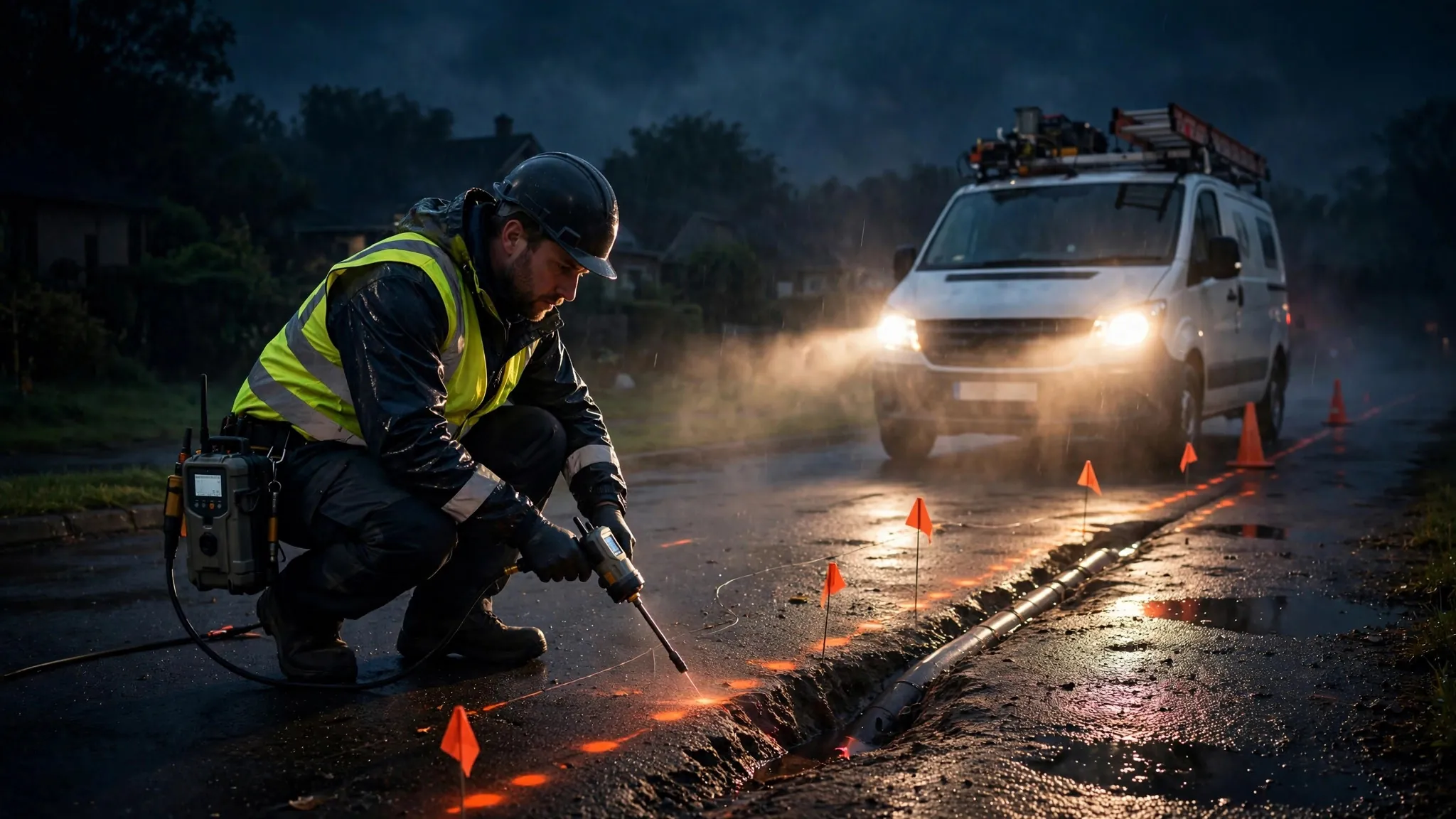
Yes — acoustic detection actually performs better at night when ambient noise drops. Emergencies do not wait for daylight.
We mark it with a depth estimate regardless of surface. The repair is a surgical cut at the mark, not a full replacement.
Very — it erodes soil continuously, wastes water massively, and can undermine structures. Shut the main and call now.
Buried breaks erode soil by the hour. We arrive in 30–45 minutes, 24/7 — call (617) 380-4912.