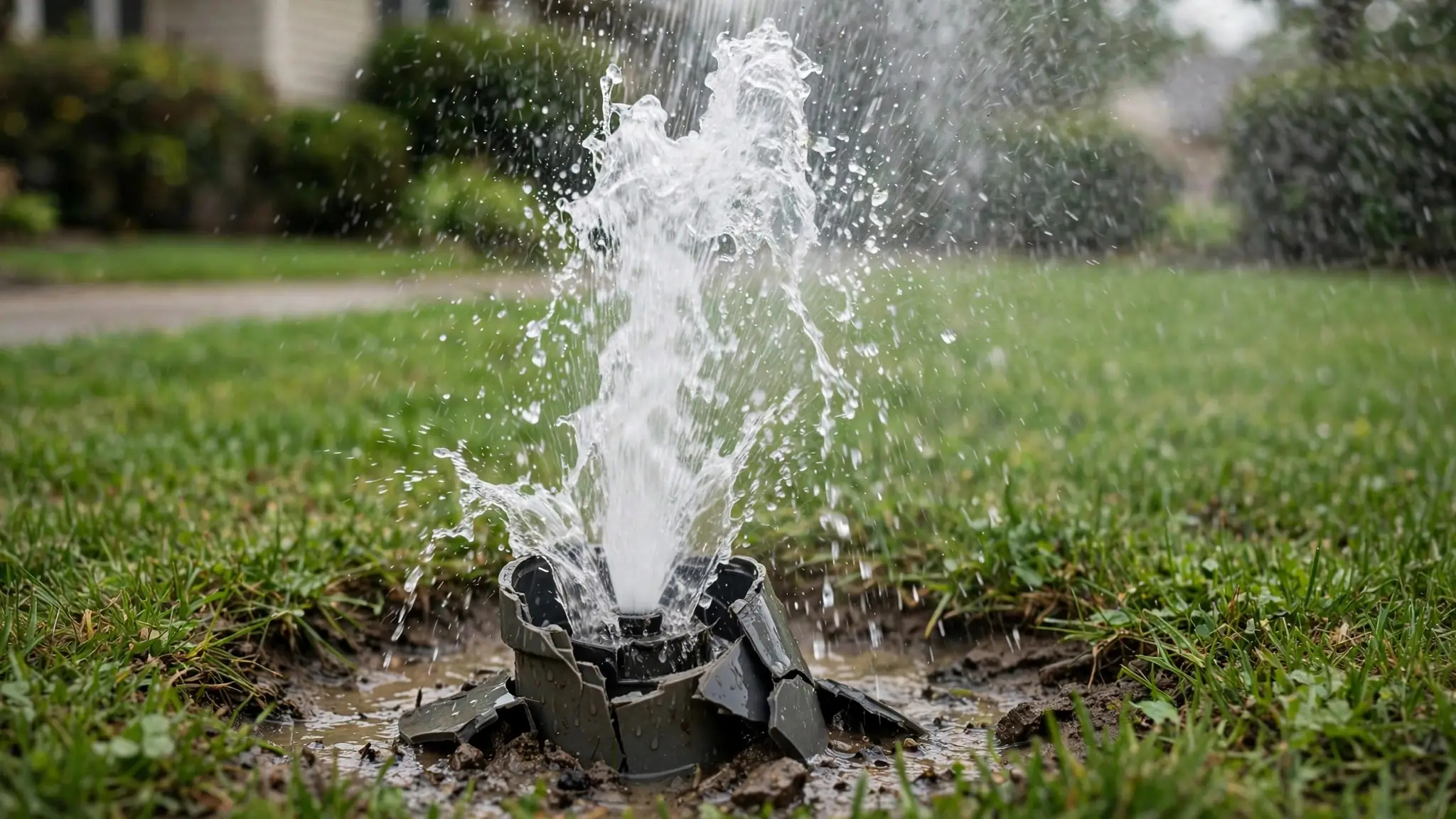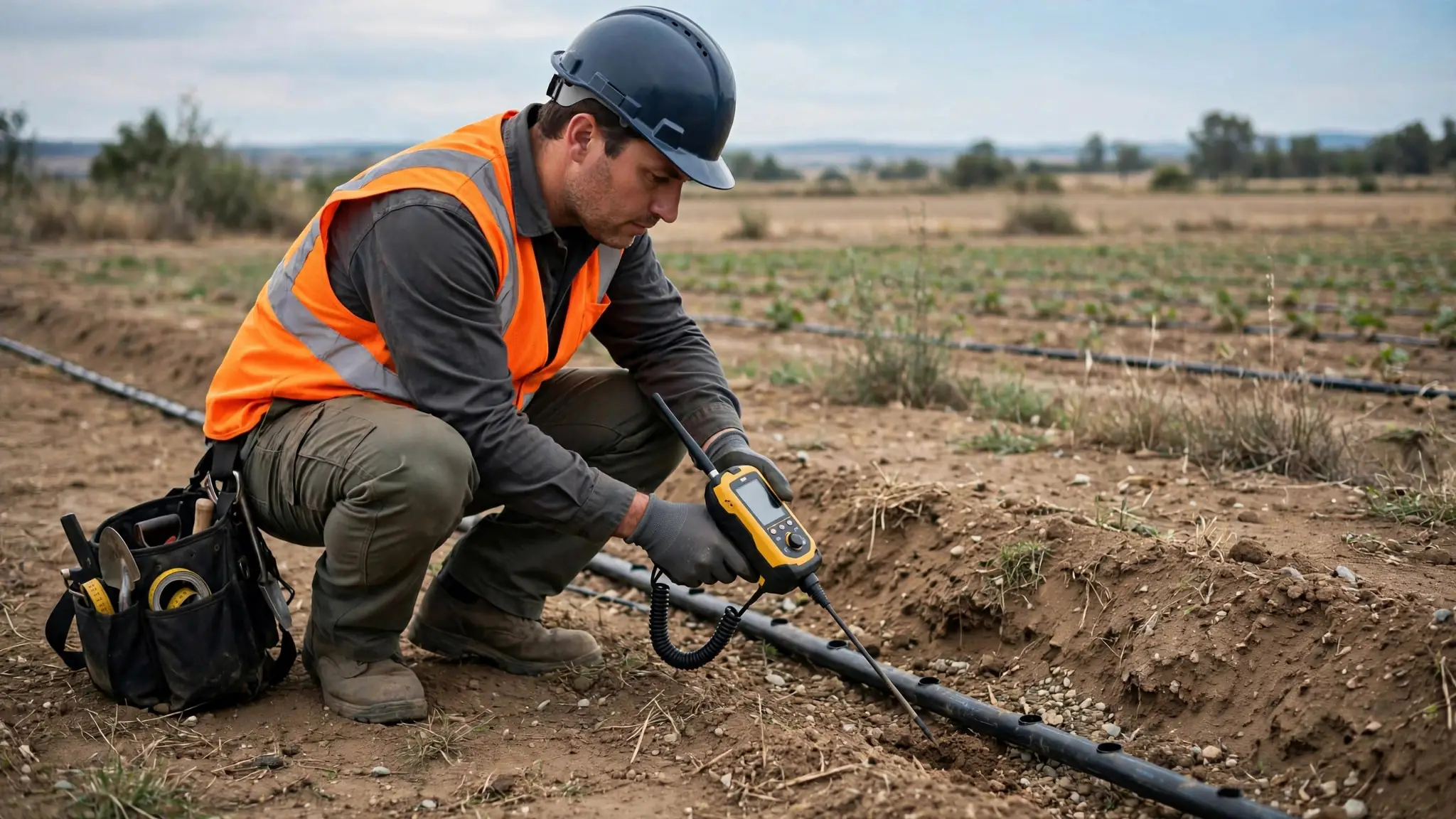
Irrigation leak detection locates breaks in sprinkler mainlines, lateral lines, valves, and heads using zone isolation, pressure testing, and acoustic methods — without digging up the yard to search. The process is systematic: first identify the affected zone (the zone comparison from our symptom guide), then isolate and pressure-test that zone's lateral, then pinpoint the break for targeted excavation. Mainline leaks (pressurized 24/7) are found via meter testing and acoustic survey; lateral leaks (pressurized only when running) via zone testing. Professional irrigation detection turns a soggy mystery into a marked dig site.
Quick Answer
Detection starts with zone identification (which zone is weak/soggy), then isolates that zone's lateral for pressure testing — pressure drop confirms the break and characterizes its size. Acoustic listening pinpoints mainline breaks (pressurized constantly). The break is marked for a surgical excavation, not trenching. Smart controllers with flow monitoring automate the first step by alerting on abnormal zone flow.
Step 1: Zone Identification
Every irrigation detection begins by naming the zone — the systematic walk from our symptom guide:
- Run each zone manually at the controller, walking the full coverage area.
- Record per zone: pressure quality, head function, wet/dry anomalies, and valve condition.
- Identify the outlier — the weak, soggy, or malfunctioning zone.
- Check the valve box for that zone — water in the box or a running-when-off valve narrows the diagnosis.
This step is diagnostic, not just observational — the zone comparison distinguishes lateral breaks (one zone affected) from mainline issues (all zones or meter flow with the system off).
Step 2: Pressure Testing The Lateral
Once the zone is identified, its lateral line is isolated and pressure-tested:
- Isolate: cap the heads or isolate the lateral at the valve.
- Pressurize: introduce controlled pressure (water or air) into the isolated lateral.
- Monitor: pressure holding means the lateral is sound (look at heads/valves instead); pressure dropping confirms a lateral break.
- Characterize: the rate of drop indicates the break's size — rapid drop means a major break; slow drop means a small crack or weeping joint.
Pressure testing confirms what the zone walk suspected — and rules out head and valve issues when the lateral holds.
Isolate Before You Dig
Pressure testing the isolated lateral is the step that prevents exploratory excavation. A holding lateral means the problem is heads or valves (accessible, no digging); a dropping lateral means a buried break (dig at the marked point, not randomly). The test directs the shovel.
Step 3: Acoustic Pinpointing
For pressurized breaks (mainline, or laterals under test pressure), acoustic listening pinpoints the location:
- Ground microphones survey along the line's route; the break's turbulence signature peaks at the breach.
- Works through soil and turf — no excavation needed for the survey itself.
- Best conditions: quiet periods (early morning), with the line pressurized.
- Marks the dig site — typically within a foot or two, for a surgical excavation.
Mainline Detection: The 24/7 Leak
Mainline leaks — breaks in the constantly-pressurized line before the zone valves — are detected differently:
- Meter test: with the irrigation main on but all zones off, meter flow means a mainline leak (or a stuck valve — check valve boxes first).
- Valve elimination: shut each zone valve manually; if the flow stops, it is a valve, not the mainline.
- Acoustic survey: with the mainline pressurized, walk the mainline route acoustically — the break's signature marks the location.
- Visual tracing: mainline leaks often surface as persistently wet areas along the mainline route (usually the most direct path from the water source to the valve manifold).
Mainline leaks are urgent — they waste water continuously. The meter test takes minutes; do not delay it when mainline involvement is suspected.
Valve Diagnosis: The Accessible Culprit
Zone valves — in their accessible boxes — are diagnosed directly:
| Valve Symptom | Likely Cause | Fix |
|---|---|---|
| Zone runs continuously | Debris holding valve open; failed diaphragm | Disassemble, clean, replace diaphragm |
| Zone will not activate | Failed solenoid; wiring break; no water | Test solenoid; trace wiring; verify supply |
| Valve box full of water | Valve body or connection leak | Inspect and repair/replace |
| Zone weeps constantly | Worn diaphragm not sealing fully | Diaphragm replacement |
| Manual bleed leaks | Bleed screw not closed or damaged | Close or replace bleed screw |
From Detection To Repair
- Marked location — the break marked for excavation (typically a 2x2 foot surgical dig, not trenching).
- Expose: careful hand digging around the marked point (avoiding other utilities — call 811).
- Repair: cut out the broken section; install repair couplings or a new section.
- Test: pressurize and verify before backfilling.
- Restore: backfill, compact, and restore turf.
Most irrigation lateral repairs are half-day jobs once located — the detection is the skilled part; the repair is straightforward.
Prevention: The Smart Approach
- Flow-monitoring controllers — detect abnormal zone flow automatically; the highest-value upgrade.
- Spring startup inspections — catch winter damage before the watering season.
- Winterization blowouts — prevent freeze damage, the leading cause of spring leaks.
- Head maintenance — replace damaged heads promptly; broken heads stress the zone hydraulically.
- Pressure regulation — excessive pressure stresses fittings and joints; regulate at the source.
For irrigation leak symptoms and soggy lawn diagnosis, see our companion guides.
DIY Detection Limits: Know The Boundary
Homeowners can identify the zone (the systematic walk) but should recognize where DIY ends:
| Task | DIY | Professional |
|---|---|---|
| Zone-by-zone walk | Yes — the essential first step | — |
| Valve box inspection | Yes — visual and basic cleaning | Electrical diagnosis |
| Head replacement | Yes — straightforward | — |
| Pressure testing laterals | — | Yes — calibrated equipment required |
| Acoustic pinpointing | — | Yes — professional microphones |
| Mainline location | Meter test only | Yes — full acoustic survey |
The Irrigation Water Audit
A water audit quantifies your irrigation efficiency — and reveals hidden leaks:
- Measure zone output: place catch cups across the zone; run for 15 minutes; measure collected water.
- Calculate uniformity: even distribution means an efficient zone; dry spots indicate blockages or pressure issues.
- Compare against the meter: the metered volume should match the calculated output; excess means leaks.
- Benchmark seasonally: repeat annually; declining efficiency indicates developing problems.
The audit quantifies what the zone walk observes — together, they provide a complete irrigation health picture.
Audit In Spring
Run the water audit at spring startup — it establishes the season's baseline and catches winter damage before the watering season compounds the waste. A 30-minute audit prevents a season of overwatering.
Irrigation Detection Case Studies
Case 1 — The weak zone: Zone 3 noticeably weaker than others. Zone walk confirms; pressure testing shows rapid drop. Acoustic pinpoints the break 40 feet from the valve. Surgical dig, coupling repair, half-day total.
Case 2 — The mystery bill: Water bill doubled; zones look normal. Meter test with system off shows flow — mainline leak. Acoustic survey traces the mainline; the break is under the driveway. Targeted cut, repair, restoration — no trenching.
Case 3 — The stuck valve: Zone runs continuously. Valve box inspection reveals debris; cleaning resolves it. No detection needed — the zone walk and valve check sufficed. Not every symptom needs instruments.
Emerging Irrigation Technology
- Soil moisture sensors: zone-level sensing preventing overwatering and revealing anomalies.
- Flow totalizers: per-zone flow measurement; deviations trigger alerts.
- Smart controllers with AI: learning normal patterns and predicting failures.
- Acoustic monitoring: permanent sensors listening for break signatures continuously.
For irrigation symptoms and soggy lawn diagnosis, see our companion guides. Professional irrigation detection handles the cases beyond DIY.
The Cost Of Undetected Irrigation Leaks
| Leak Type | Waste Pattern | Seasonal Impact |
|---|---|---|
| Broken lateral | Full zone flow per cycle | Thousands of gallons per season |
| Mainline break | Continuous 24/7 | Unbounded until repaired |
| Stuck valve | Zone runs continuously | Severe — full zone flow nonstop |
| Weeping heads | Constant dribble | Moderate but persistent |
The water bill quantifies your specific waste — compare irrigation-season bills against winter baselines. The difference is the irrigation system's total consumption; anomalies within it indicate leaks. High bill diagnosis covers the analysis method.
Working With Irrigation Contractors
- Detection vs. repair: some providers do both; others detect and refer. Clarify the scope upfront.
- Marked locations: insist on physical marking — the repair's precision depends on it.
- System assessment: while on-site, have the contractor assess overall system health — aging systems benefit from comprehensive evaluation.
Seasonal Irrigation Management
Effective irrigation leak prevention follows the seasons:
- Spring: startup inspection (every zone walked), pressure check, and repair of winter damage before the watering season.
- Summer: monthly zone observations; bill monitoring for anomalies; immediate response to weak zones.
- Fall: pre-winter inspection; schedule the blowout winterization; repair issues before shutdown.
- Winter: system off and winterized; no irrigation concerns — but plan spring improvements.
The spring startup is the highest-value 30 minutes in irrigation management — winter damage caught in April costs a fraction of summer water bills. Zone symptom guide for the walkthrough method.
ROI Of Irrigation Leak Detection
- Water savings: a single repaired lateral often saves thousands of gallons per season.
- Landscape protection: proper watering (not overwatering from leaks) produces healthier landscapes.
- Equipment longevity: running a compromised system stresses valves, pumps, and remaining lines.
- Detection cost vs. waste: the diagnostic typically pays for itself within weeks of stopping the leak.