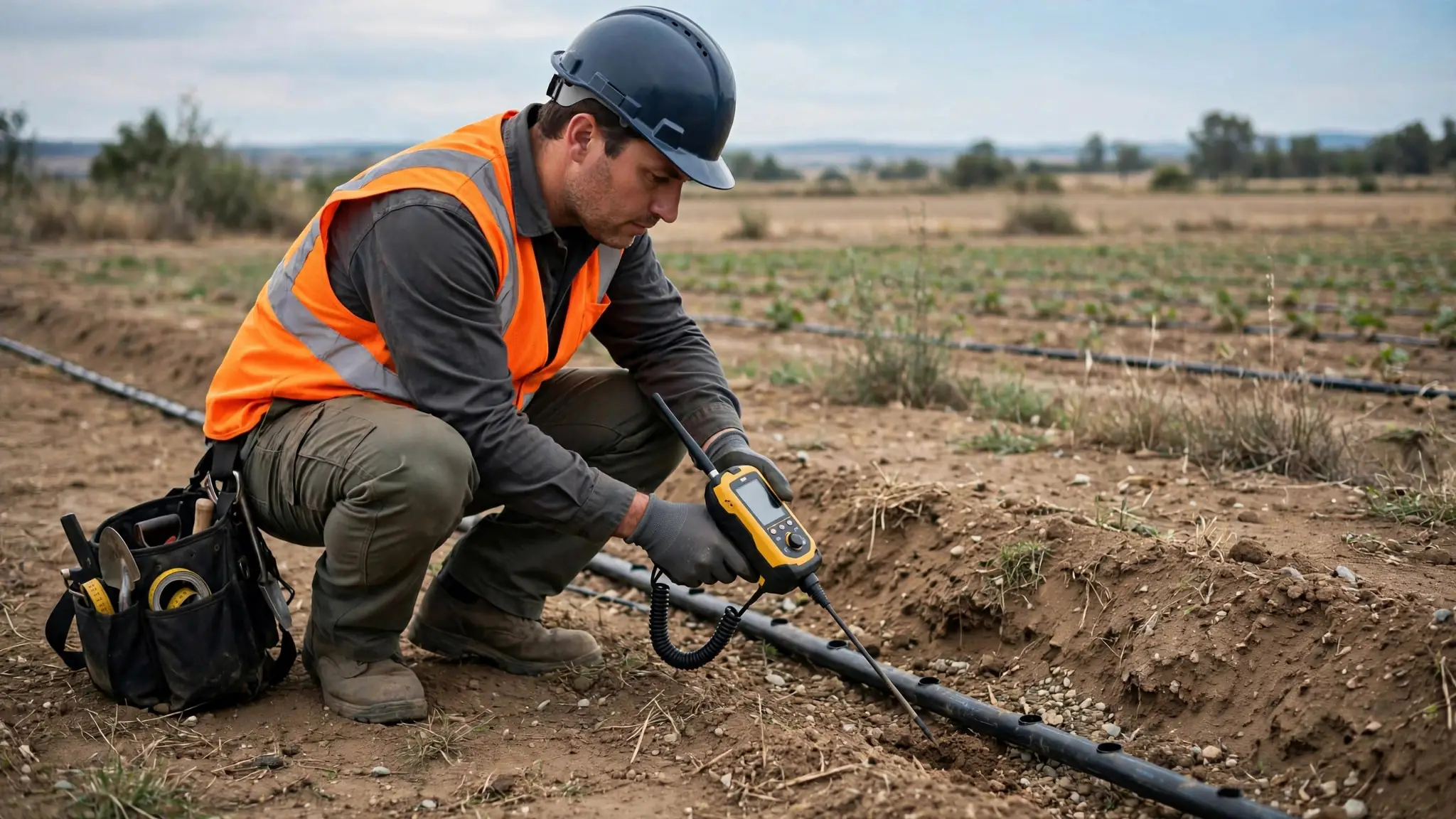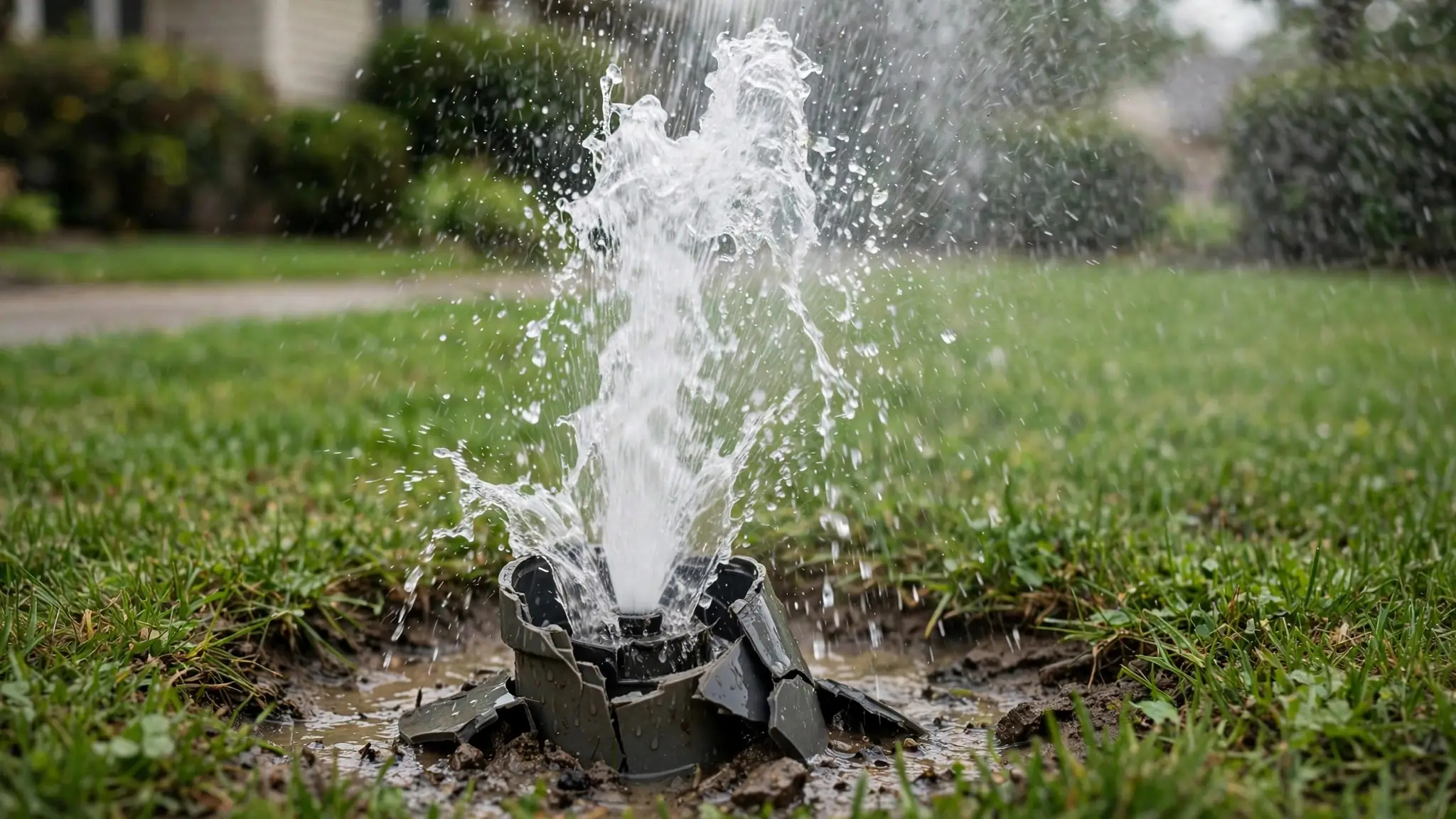
A sprinkler zone not working right — weak pressure, uneven coverage, geysers, or soggy patches — usually means an irrigation line leak: a cracked lateral line, broken head, stuck valve, or damaged mainline. Irrigation leaks are uniquely wasteful because they discharge directly into soil, often for entire watering cycles, and many run at night when no one observes. Signs include one weak zone while others are normal (the zone with the break loses pressure), geysers or misting (broken heads), persistently soggy areas (broken laterals), and water bills climbing with watering season. Professional irrigation leak detection finds underground breaks without digging up the yard.
Quick Answer
Compare zones: one weak zone while others are strong means the break is in that zone (not the mainline). Look for geysers (broken heads — visible), soggy patches (broken laterals — the water surfaces), and heads that do not pop up (pressure lost upstream). Check the valve box for the zone — a stuck valve runs continuously. Confirm with the meter: flow with the system off means a mainline leak; flow only during the zone's schedule means a lateral leak. Then walk the zone systematically or call for professional detection.
What To Do Right Now
- Run each zone manually and walk it — observe pressure, coverage, geysers, and soggy areas per zone.
- Compare zones. One weak zone = lateral break in that zone; all weak = mainline or supply issue.
- Check valve boxes. Water in the box, or a zone running when it should not = valve problem.
- Note the bill pattern. Seasonal spikes tracking watering season implicate irrigation.
- Shut the irrigation main if a major break is suspected — stop the loss while diagnosing.
- Call for detection if the break is underground — irrigation leak detection.
Need Help Right Now?
Geysering break, major soggy area, or water running uncontrollably? Shut the irrigation main and call now.
Call (617) 380-4912The 7 Signs Of An Irrigation Line Leak
1. One Zone Noticeably Weaker
The most diagnostic sign: a single zone with low pressure, short throw, or uneven coverage while other zones perform normally. The break vents pressure in that zone's lateral — the zone tells you where to look.
2. Geysers Or Misting Heads
Broken sprinkler heads erupt vertically (geyser) or spray mist — visible, dramatic, and wasteful. Usually caused by mower damage, foot traffic, or age. The simplest irrigation leak to find and fix.
3. Persistently Soggy Patches
Broken lateral lines discharge underground, surfacing as soggy patches — often between heads (not at them). The patch persists between watering cycles (unlike normal wetness that dries).
4. Heads That Do Not Pop Up
Pop-up heads need pressure to rise — a lateral break upstream steals the pressure, leaving heads down or dribbling. Multiple down heads in one zone trace the break's upstream position.
5. Water Running When The System Is Off
A zone that runs continuously or will not shut off indicates a stuck valve (debris, diaphragm failure, or electrical issue) — the zone's water never stops.
6. Unusually High Water Bills
Bills that spike with watering season and drop when winterized point to irrigation — the system is the seasonal variable. High bill diagnosis in detail.
7. Lush Stripes Or Dead Stripes
Overly lush stripes follow leaking laterals (constant moisture); brown/dead stripes follow the pressure-starved areas downstream of the break. The lawn maps the leak.
The Zone Comparison Is Key
Always compare the suspect zone against a known-good zone. The contrast — weak vs. strong, soggy vs. dry, lush vs. normal — is more diagnostic than any single observation. Irrigation diagnosis is comparative.
Zone-By-Zone Diagnosis: The Systematic Walk
- Activate one zone at a time manually at the controller.
- Walk the full zone — every head, the ground between heads, and the valve box.
- Record per zone: pressure quality, head function, wet/dry anomalies, valve condition.
- Identify the outlier zone(s) — the diagnosis lives in the difference.
- Within the outlier zone: the wettest point or the pressure drop-off point marks the break's vicinity.
Valve Problems: The Control Point
- Stuck open: zone runs continuously — debris in the valve, failed diaphragm, or manual bleed left open.
- Will not open: electrical (solenoid, wiring) or water supply issue — the zone stays dry.
- Weeping: slow leak through a worn diaphragm — the zone is perpetually damp.
- Valve box full of water: the valve or its connections leak — inspect directly.
Valve issues are accessible (in boxes, not buried) and often DIY-serviceable (cleaning, diaphragm replacement). But electrical diagnosis (solenoid, wiring, controller) benefits from professional eyes.
Mainline Vs Lateral: The Critical Distinction
| Feature | Mainline Leak | Lateral (Zone) Leak |
|---|---|---|
| Pressurization | Pressurized 24/7 (before valves) | Pressurized only when zone runs |
| Symptoms | All zones weak; meter flows with system off | One zone weak; normal when zone off |
| Water waste | Continuous — the worst irrigation leak | During watering cycles only |
| Detection | Meter test with system off | Zone-by-zone walk; pressure testing |
| Urgency | High — never stops | Moderate — bounded by schedule |
Mainline leaks are the serious irrigation leaks — pressurized constantly, wasting water 24/7, and invisible (buried before the valves). The meter test with the irrigation main off vs. on distinguishes: flow with everything off = mainline leak.
The Bill Connection
Irrigation leaks hit bills seasonally and severely:
- Mainline leaks run year-round (if the system stays pressurized) — a constant bill elevation.
- Lateral leaks run per watering schedule — the bill tracks the controller's programming.
- A single broken lateral can waste as much as a household's entire indoor usage — irrigation flows are large.
- Smart controllers with flow monitoring detect anomalies automatically — the best prevention.
What Happens If You Wait
- Water waste compounds — irrigation leaks are high-volume; every cycle wastes significantly.
- Landscape damage — overwatered areas (root rot, fungus) and underwatered areas (drought stress) simultaneously.
- Soil erosion — discharging laterals erode soil, creating voids and surface collapse.
- System deterioration — running a compromised system stresses valves, heads, and the remaining laterals.
DIY Vs Professional
| Situation | Safe DIY | Call A Professional |
|---|---|---|
| Broken head (geyser) | Replace the head — straightforward | If the break extends below the head |
| Stuck valve | Clean; check diaphragm; verify wiring | Electrical issues; repeated sticking |
| Soggy patch, known zone | Walk the zone; probe gently | Irrigation detection for underground breaks |
| Mainline leak suspected | Shut the irrigation main; confirm with meter | Professional location promptly — continuous waste |
| Multiple zones affected | Check the mainline and supply | Professional — systemic issue |
How Professionals Find Irrigation Leaks
Irrigation leak detection uses zone isolation (confirming which zone), pressure testing (pressurizing the lateral and watching for drop), acoustic listening (for mainline and pressurized breaks), and systematic excavation at the marked point — not trenching the yard. How irrigation detection works in detail. For soggy lawn diagnosis (distinguishing irrigation from supply leaks), see our companion guide.
Smart Irrigation: Leak Detection Built In
Flow-monitoring smart controllers transform irrigation leak management:
- Learn normal flow per zone during setup.
- Alert on anomalies — high flow (break) or low flow (blockage) triggers notifications.
- Auto-shutoff — some controllers close the main on catastrophic flow, limiting waste.
- Zone-level granularity — the alert names the zone, focusing the physical inspection.
For properties with irrigation leak history, a smart controller pays for itself in prevented water waste — often within a single season.
Seasonal Irrigation Discipline
| Season | Action | Leak Relevance |
|---|---|---|
| Spring startup | Inspect every zone; pressure-check; repair winter damage | Catch freeze damage before watering season |
| Summer operation | Monthly zone walks; bill monitoring | Catch developing leaks early |
| Fall | Pre-winter inspection; schedule blowout | Repair before winter; close cleanly |
| Winter | Blowout winterization; system off | Prevent freeze damage — the #1 cause |
The Spring Startup Inspection
The most valuable 30 minutes in irrigation: at spring startup, run every zone and walk every inch before the watering season begins. Winter damage caught in April costs a fraction of what it costs as a summer water bill.
Quantifying Irrigation Waste
Irrigation leaks waste at irrigation scale — understanding the numbers motivates action:
- Typical zone flow: 5-15 gallons per minute; a broken lateral can discharge at full zone flow.
- Per cycle: a 30-minute cycle at 10 GPM wastes 300 gallons — per cycle, per break.
- Per season: daily cycles compound to tens of thousands of gallons from a single break.
- Mainline leaks: continuous 24/7 — the waste has no upper bound until repaired.
These numbers explain why irrigation leaks dominate water bills — and why prompt detection has such high ROI.
Professional Irrigation Detection: What To Expect
- Zone isolation and testing — confirming the affected zone systematically.
- Pressure testing — pressurizing laterals to confirm and characterize the break.
- Acoustic methods — for mainline and pressurized breaks.
- Marked location — the break marked for targeted excavation, not trenching.
- Repair or referral — many detection providers repair directly; others mark for your irrigation contractor.
For how irrigation detection works and soggy lawn diagnosis, see our companion guides.