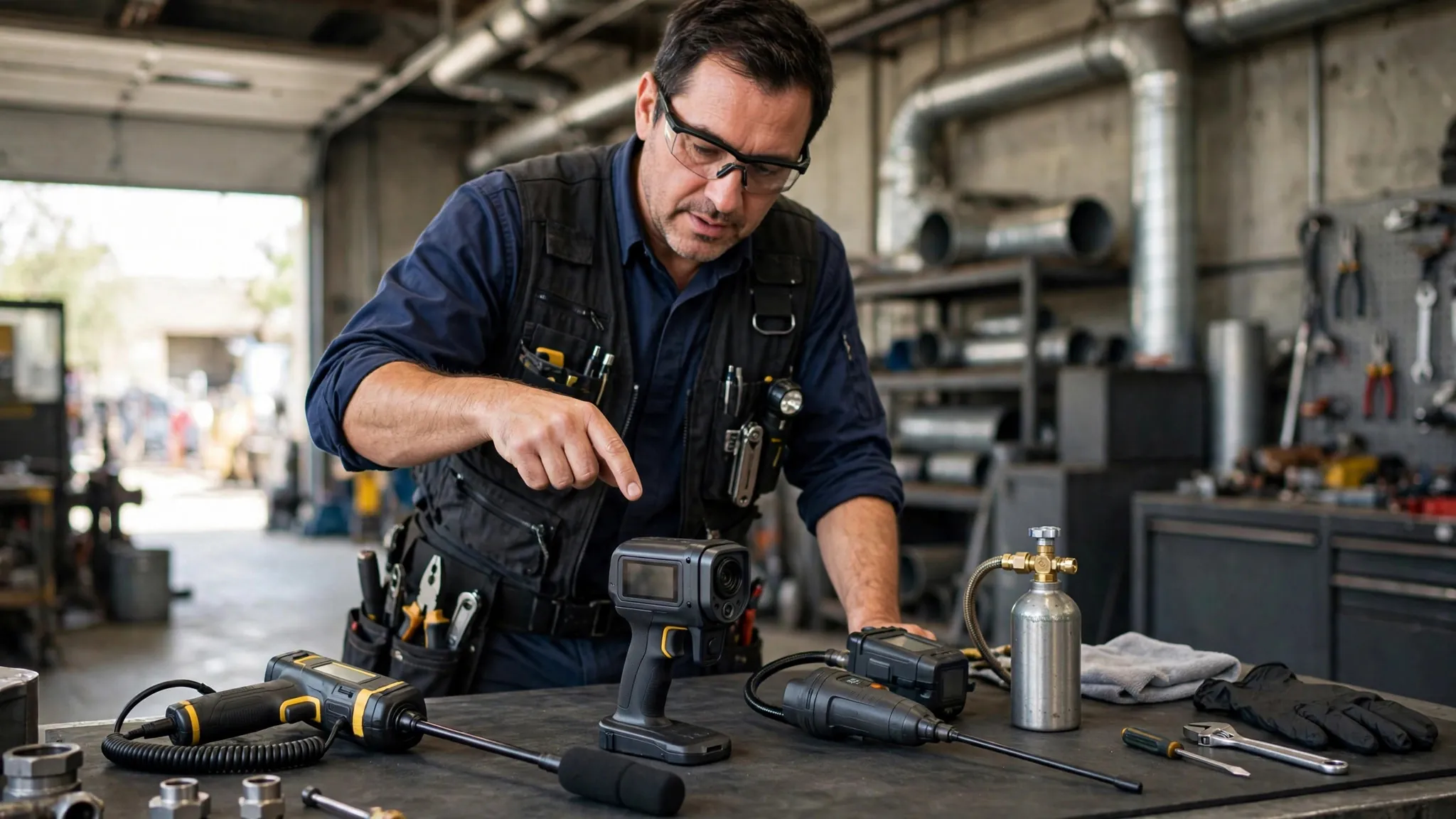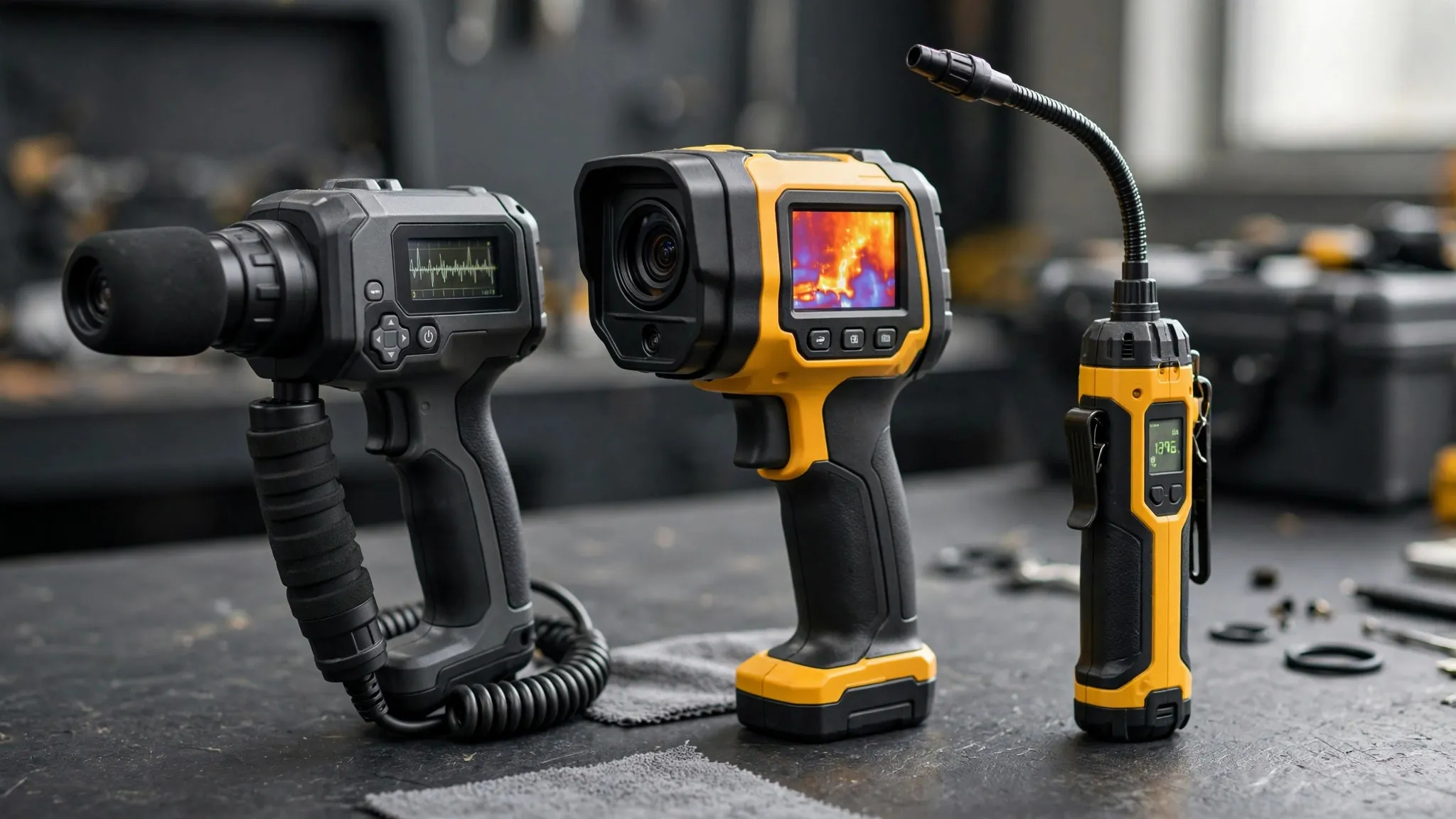
Professional leak detection relies on three primary technologies — acoustic (listening for the leak's sound), thermal (seeing temperature anomalies), and tracer gas (tracking a safe gas escaping through the break). Each detects differently, excels in different situations, and has different limitations. Professionals rarely rely on just one — cross-verification between methods is what produces confident locations. This guide explains each method, compares them directly, and clarifies when each is the right tool. Professional leak detection deploys the right combination for your specific leak.
Quick Answer
Acoustic detection listens for pressurized leaks' sound signatures — best for supply lines under slabs and underground, requiring active pressure. Thermal imaging detects temperature anomalies from moisture — best for hot-water leaks, wall/ceiling tracing, and large-area screening. Tracer gas (safe hydrogen-nitrogen) pinpoints breaks by detecting gas escaping through them — best for confirming locations and finding leaks other methods miss. Professionals combine methods; the combination, not any single tool, delivers certainty.
Acoustic Detection: Listening For Leaks
How it works: pressurized water escaping through a break creates turbulence — a distinctive sound signature. Highly sensitive microphones (ground microphones, contact sensors, listening sticks) detect this signature through soil, concrete, and building materials. The technician surveys along the pipe's route; the signal peaks at the breach.
Strengths:
- Precise — often locates within inches on pressurized lines.
- Works through materials — soil, concrete, asphalt, and walls.
- Real-time — immediate feedback during the survey.
- Quantitative — signal strength correlates with leak severity.
Limitations:
- Requires pressure — the leak must be active; no pressure, no sound.
- Background noise interferes — traffic, machinery, and building systems mask signatures (quieter conditions are better).
- Not for drain leaks — non-pressurized leaks are silent.
- Deep or small leaks are harder — signal attenuates with distance and diminishes with size.
Thermal Imaging: Seeing Temperature
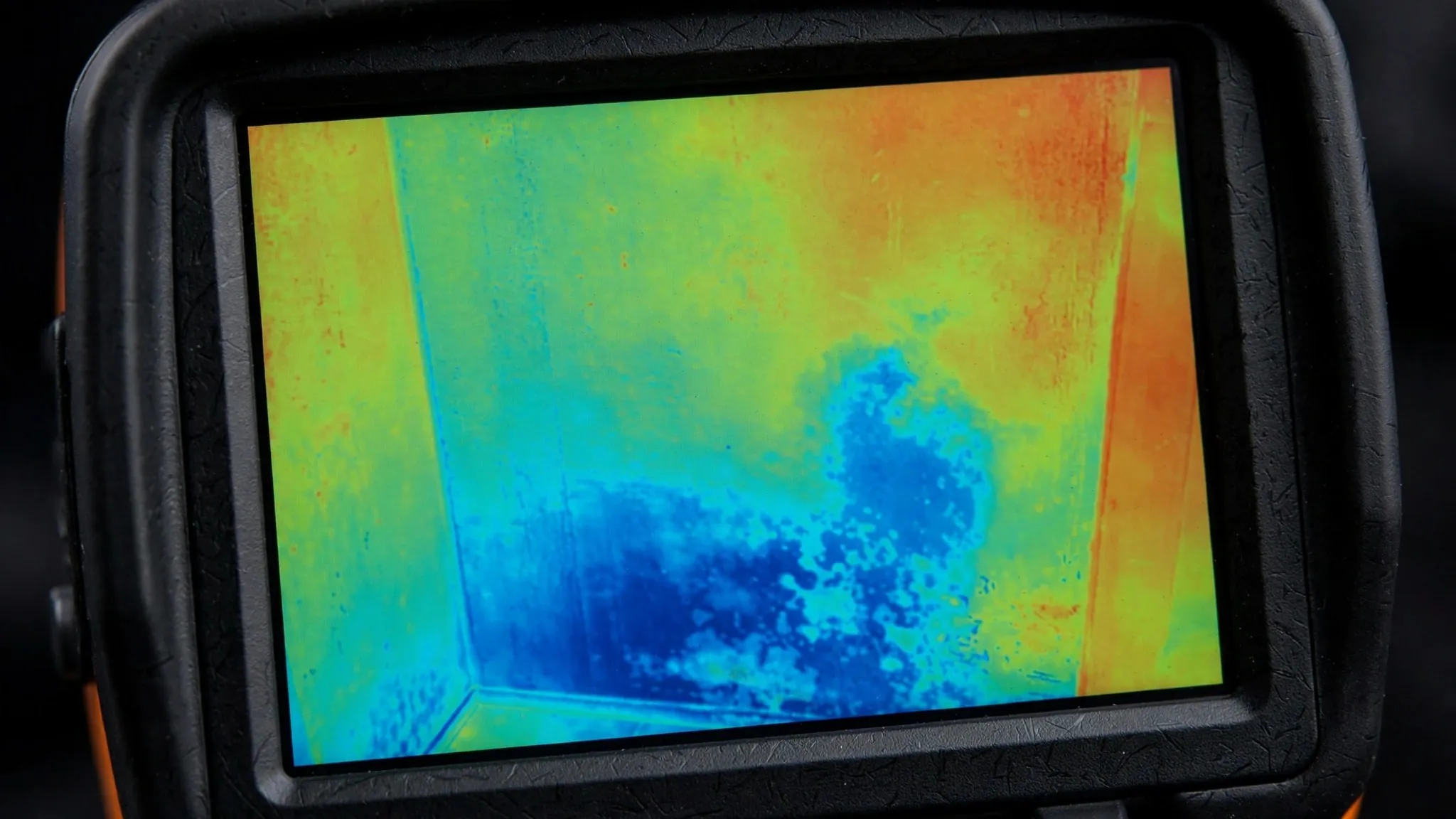
How it works: infrared cameras detect surface temperature differences. Hot-water leaks create warm anomalies; any moisture cools through evaporation, appearing cooler than dry surroundings. The thermal pattern reveals the water's location and migration path.
Strengths:
- Large-area screening — scans entire floors, walls, and ceilings in minutes.
- Non-contact — no surface contact needed; works through paint and finishes.
- Hot-water specialist — warm anomalies are unambiguous for hot supply leaks.
- Moisture mapping — defines the wet area's extent, guiding repair scope.
Limitations:
- Shows temperature, not moisture — interpretation distinguishes leaks from insulation gaps, thermal bridging, and solar effects.
- Surface only — detects surface temperature effects; deep leaks may not register.
- Environmental sensitivity — sunlight, HVAC, and ambient conditions affect readings.
- Cold-water leaks are subtler — evaporative cooling only, no warm signature.
Tracer Gas Detection: Following The Gas
How it works: a safe mixture (typically 95% nitrogen, 5% hydrogen — non-flammable, non-toxic) is introduced into the isolated pipe. The gas escapes through the break and migrates to the surface, where a highly sensitive detector pinpoints the emergence point — marking the break's location.
Strengths:
- Extremely sensitive — detects very small leaks other methods miss.
- Definitive location — the gas emerges at the break; the mark is the dig site.
- Works without water flow — the line is drained and filled with gas; no active leak needed.
- Confirms other methods — the gold-standard verification before excavation.
Limitations:
- Requires isolation — the line must be isolated, drained, and accessed for gas introduction.
- More setup — longer preparation than acoustic or thermal surveys.
- Soil conditions matter — very dense or saturated soils slow gas migration.
- Not a screening tool — it confirms and pinpoints; it does not survey large areas efficiently.
Safe By Design
Tracer gas (5% hydrogen in nitrogen) is non-flammable, non-toxic, and dissipates harmlessly. It is the same principle used in industrial leak testing worldwide. The 'gas' in tracer gas detection is safer than the air in the room.
Head-To-Head Comparison
| Factor | Acoustic | Thermal | Tracer Gas |
|---|---|---|---|
| Detects | Sound of escaping water | Temperature anomalies | Gas escaping through break |
| Requires | Active pressure | Temperature differential | Line isolation + gas fill |
| Best for | Pressurized supply leaks | Hot-water leaks; large areas | Pinpoint confirmation; small leaks |
| Precision | Inches (when conditions good) | Feet (area definition) | Inches (definitive) |
| Speed | Fast survey | Fastest screening | Slower (setup intensive) |
| Limitation | Needs pressure; noise-sensitive | Surface only; interpretation needed | Needs isolation; not for screening |
Why Professionals Combine Methods
No single method is always right — but their combination is nearly always conclusive:
- Thermal screens the large area quickly, identifying the anomalous zone.
- Acoustic surveys the zone, isolating the break's sound signature.
- Tracer gas confirms the marked location before any excavation.
When all three agree, the location is certain — and the repair is surgical. When they disagree, the disagreement itself is informative (different methods detecting different aspects), guiding further investigation rather than premature digging.
Single-method detection is a risk — it is the professional equivalent of a single symptom diagnosis. Cross-verification is the standard of care.
Which Method For Your Situation
| Your Situation | Primary Method | Why |
|---|---|---|
| Slab leak (hot water) | Thermal + acoustic | Warm anomaly screens; acoustic pinpoints |
| Slab leak (cold water) | Acoustic + tracer gas | No thermal signature; sound locates, gas confirms |
| Underground service line | Acoustic + tracer gas | Buried; pressure available; gas confirms |
| Wall leak | Thermal + moisture + acoustic | Path tracing then pinpointing |
| Small/slow leak | Tracer gas | Sensitivity for what others miss |
| Large commercial slab | Thermal screening + acoustic zones | Efficiency at scale |
For slab detection in detail and wall detection in detail, see our companion guides. What to expect during a visit covers the full process.
Moisture Meters: The Supporting Tool
Moisture meters — pin and pinless — complement the big three by quantifying moisture:
- Pin meters: probes measure moisture at depth; precise but leave tiny holes.
- Pinless meters: electromagnetic scanning; non-invasive; slightly less precise.
- Role: define the wet area's extent (for repair scope) and verify dryness post-repair.
- Not locators: meters show where water is, not where it comes from — they support, not replace, the big three.
Sewer Cameras: The Drain Specialist
- Function: visual inspection of drain and sewer interiors — the definitive drain diagnostic.
- Complements: acoustic/thermal/tracer gas locate supply leaks; cameras diagnose drain issues.
- Combined use: comprehensive leak investigations use both — supply methods for pressure lines, cameras for drains.
Selecting Methods: The Professional's Decision Tree
| Question | If Yes | If No |
|---|---|---|
| Is the leak pressurized? | Acoustic is primary | Thermal + moisture lead; acoustic limited |
| Is it a hot-water line? | Thermal excels | Acoustic/tracer gas lead |
| Is the area large? | Thermal screens first | Acoustic surveys directly |
| Is precise location critical? | Tracer gas confirms | Acoustic may suffice |
| Is the leak very small? | Tracer gas (sensitivity) | Acoustic/thermal may find it |
Consumer Tools Vs Professional Equipment
| Tool | Consumer Version | Professional Difference |
|---|---|---|
| Thermal camera | Phone attachments available | Higher resolution; trained interpretation |
| Moisture meter | Hardware store pinless meters | Calibrated; gridded methodology |
| Acoustic | Stethoscope/screwdriver method | Filtered frequency analysis; ground mics |
| Tracer gas | Not available to consumers | Calibrated gas; sensitive detectors |
The interpretation gap exceeds the equipment gap — professionals bring pattern recognition from hundreds of leaks, not just better tools. Consumer thermal cameras are useful for screening (is there an anomaly worth investigating?); professional assessment provides the diagnosis.
For what to expect during a visit and slab detection detail, see our companion guides.
Limitations Of All Methods
- No method sees everything: each has blind spots; the combination covers them.
- Interpretation matters: the operator's experience exceeds the equipment's specifications in determining accuracy.
- Access required: all methods need some degree of access to the survey area.
- Not for every leak: drain leaks need cameras; gas leaks need different specialists; the right tool for the right leak.
The Future Of Leak Detection
- AI-assisted acoustic analysis: machine learning distinguishing leak signatures from noise more reliably.
- Drone thermal imaging: large-area roof and building envelope surveys.
- Permanent monitoring: installed sensors providing continuous surveillance rather than periodic surveys.
- Integration: combined platforms fusing acoustic, thermal, and moisture data automatically.
For slab detection and wall detection, see our companion guides.
Method Selection Case Studies
Case 1: Warm spot on slab. Thermal screening reveals a clear hot anomaly; acoustic pinpoints the break; tracer gas confirms. All three agree — surgical repair.
Case 2: Cold-water slab leak, no thermal signature. Acoustic surveys the route; the signal is weak (deep leak). Tracer gas pinpoints definitively. Gas succeeds where others were inconclusive.
Case 3: Wall dampness, no sound. Moisture mapping defines the extent; thermal traces the path to a shower valve. Thermal leads; moisture confirms; no acoustic needed (non-pressurized source).
The Human Factor: Technician Expertise
- Pattern recognition: experienced technicians recognize leak signatures across hundreds of prior cases.
- Method selection: knowing which method to deploy (and when to switch) is expertise, not equipment.
- Interpretation: distinguishing leak signals from background noise, thermal artifacts, and false positives.
- Honesty: acknowledging limitations and uncertainties rather than overstating confidence.
For what to expect, see our companion guide.