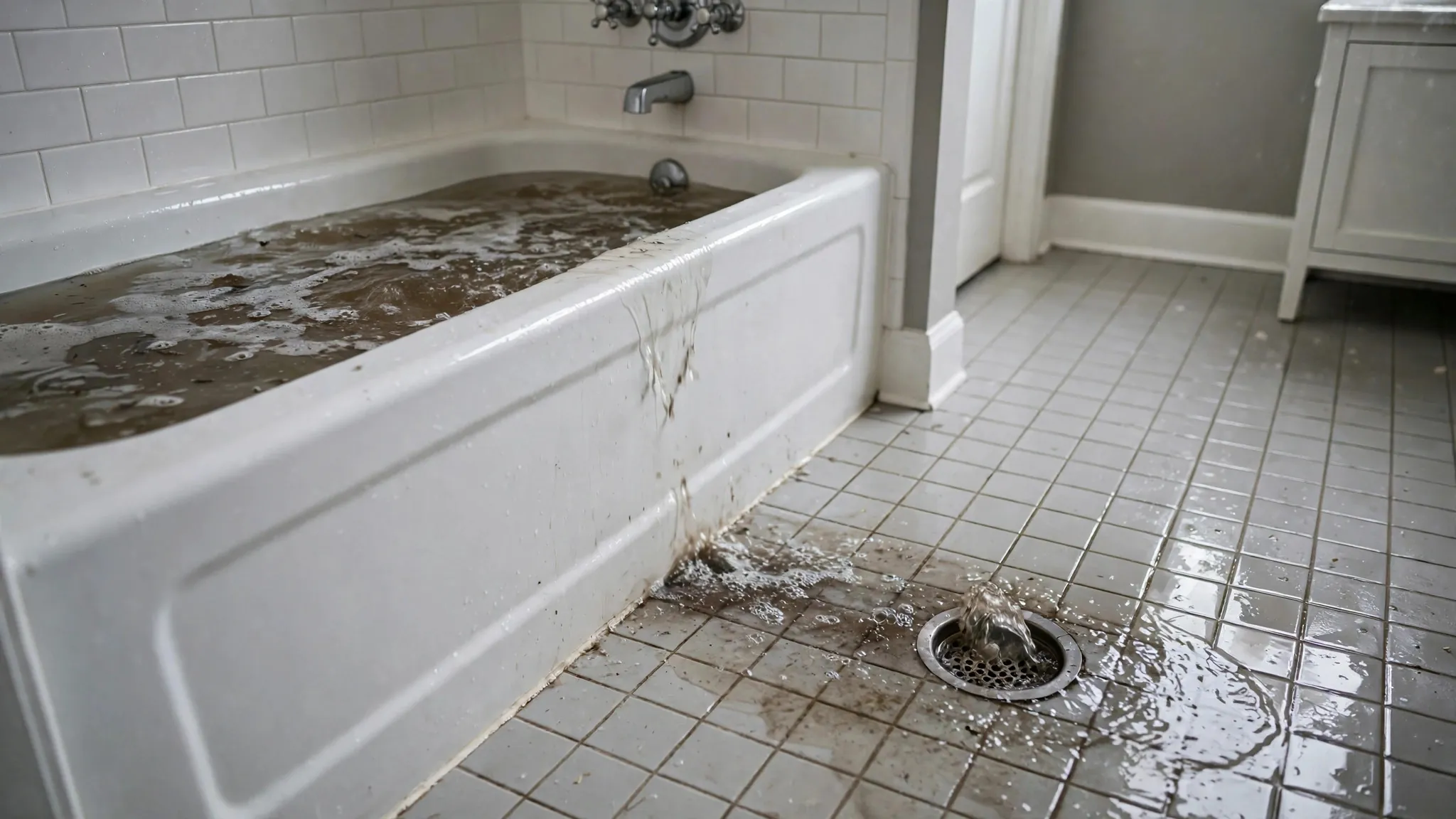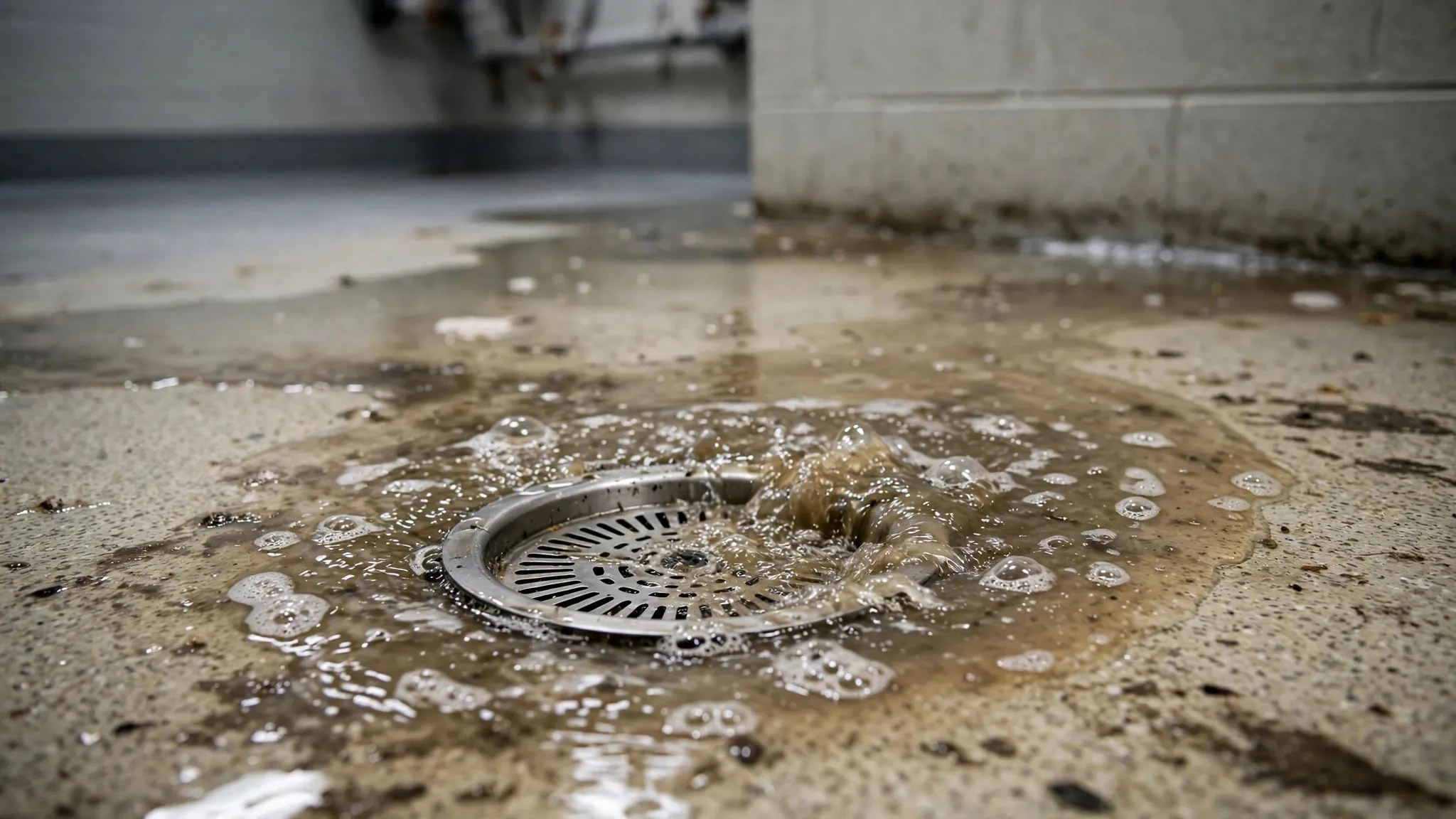
Commercial floor drain backups — water rising from floor drains instead of flowing away — indicate blockage or failure downstream in the drainage system. Common causes: grease accumulation (restaurants and food service), debris and sediment (warehouses, garages), root intrusion (older lines near landscaping), pipe collapse or bellies (aging infrastructure), and lift station failures (where pumps move wastewater). The backup's pattern diagnoses the cause: single-drain backups suggest local blockage; multiple-drain backups indicate main-line issues. Professional commercial drain service diagnoses with camera inspection and resolves the specific cause.
Quick Answer
Floor drain backups mean downstream blockage or failure. Single-drain backup: local clog (grease, debris) — mechanical clearing usually resolves. Multiple drains backing up: main-line blockage, root intrusion, pipe failure, or lift station problem — needs camera inspection for diagnosis. Recurring backups at the same drain indicate a structural issue (belly, collapse, roots), not just a clog. Commercial kitchens need grease-trap maintenance as prevention.
The 6 Common Causes
1. Grease Accumulation
Fats, oils, and grease (FOG) from food service coat drain lines, hardening into blockages. The leading cause in restaurants, cafeterias, and food processing. Builds gradually; backups worsen over weeks.
2. Debris And Sediment
Sand, grit, trash, and sediment settle in low spots and traps. Common in warehouses, garages, workshops, and loading docks — anywhere floors are washed toward drains.
3. Root Intrusion
Tree roots exploit joints and cracks in older drain lines, growing into mats that block flow. Common in older buildings near mature landscaping; recurs seasonally as roots regrow.
4. Pipe Collapse Or Bellies
Structural failures — collapsed sections, bellied (sagging) pipe holding water, offset joints. Age, ground movement, and poor installation cause them; no amount of clearing fixes structure.
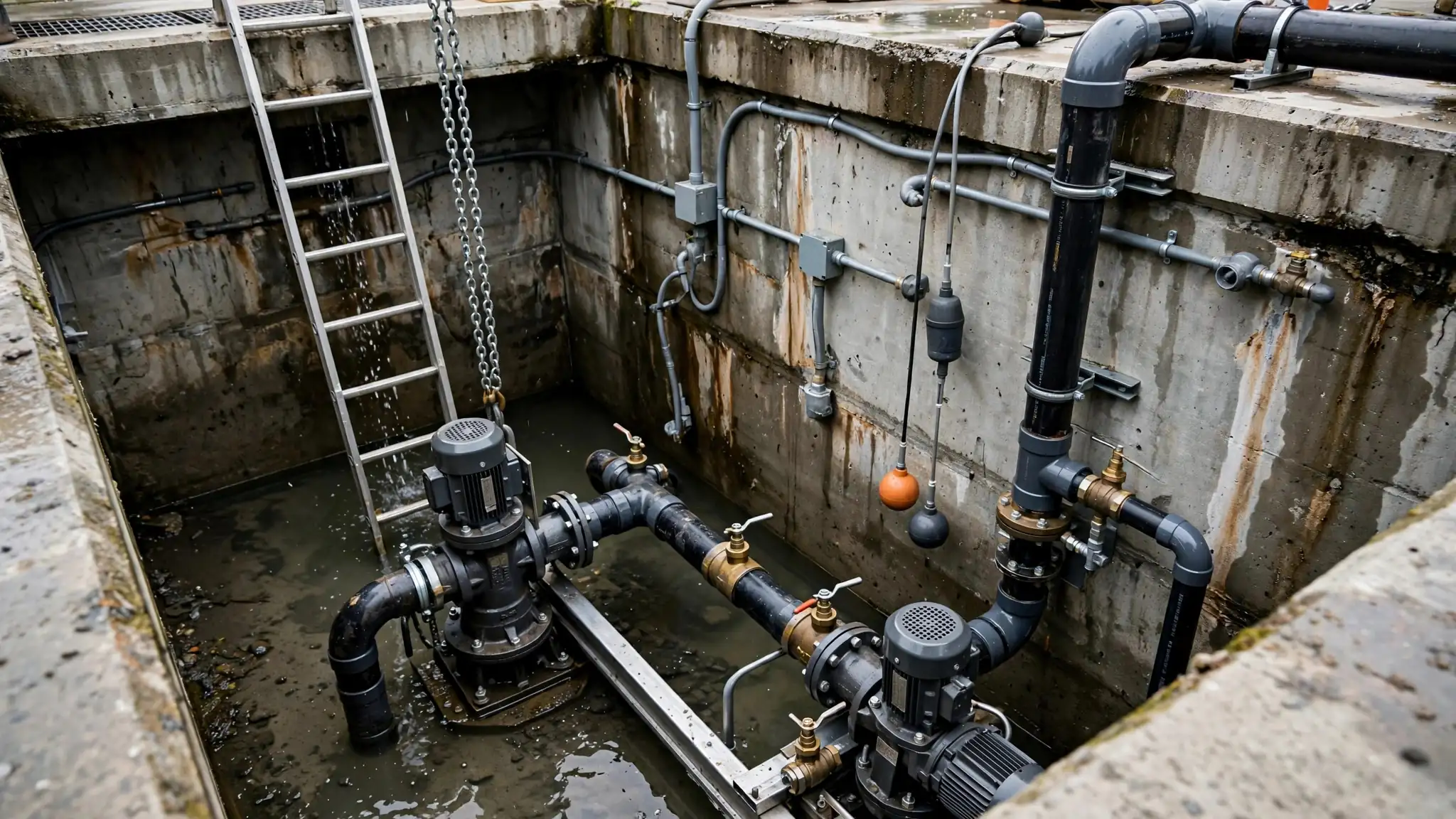
5. Lift Station Failure
Where wastewater must be pumped uphill (below-grade spaces), lift station pump or float failures back up every drain the station serves. Electrical or mechanical — urgent when it occurs.
6. Main Sewer Blockage
Blockage in the building sewer or municipal main backs up the lowest drains first. If multiple fixtures back up simultaneously, suspect the main — and check whether neighbors are affected (municipal issue) or only your building.
Reading The Backup Pattern
| Pattern | Likely Cause | Response |
|---|---|---|
| Single floor drain, occasional | Local grease/debris buildup | Mechanical clearing; trap maintenance |
| Same drain, recurring | Structural issue (belly, roots, partial collapse) | Camera inspection — find the structure |
| Multiple drains simultaneously | Main-line blockage or lift station failure | Urgent professional — main line or pump |
| Backups during heavy use | Capacity or partial blockage | Camera inspection; possible upsizing or repair |
| Backups with sewage odor | Sewer line involvement | Urgent — health hazard; professional immediately |
Recurring Means Structural
A drain that backs up, gets cleared, then backs up again is not experiencing repeated clogs — it has a structural problem (belly, roots, collapse, offset joint). Repeated clearing without camera inspection wastes money and lets the structure worsen.
Grease: The Restaurant Problem In Detail
Grease management is regulatory as well as practical — most jurisdictions require grease traps or interceptors for food service, with mandated cleaning schedules. Failure modes:
- Undersized traps — overwhelmed by volume; grease passes to the lines.
- Infrequent cleaning — the #1 cause; traps work only when maintained.
- Hot-water flushing myth — hot water moves grease downstream where it cools and hardens; it does not eliminate it.
- Enzyme/chemical treatments — supplements, not substitutes, for physical trap maintenance.
Grease backups are preventable with proper trap sizing, scheduled cleaning, and staff training (no grease down drains — scrape, then wash).
Roots And Structural Failures: The Camera Imperative
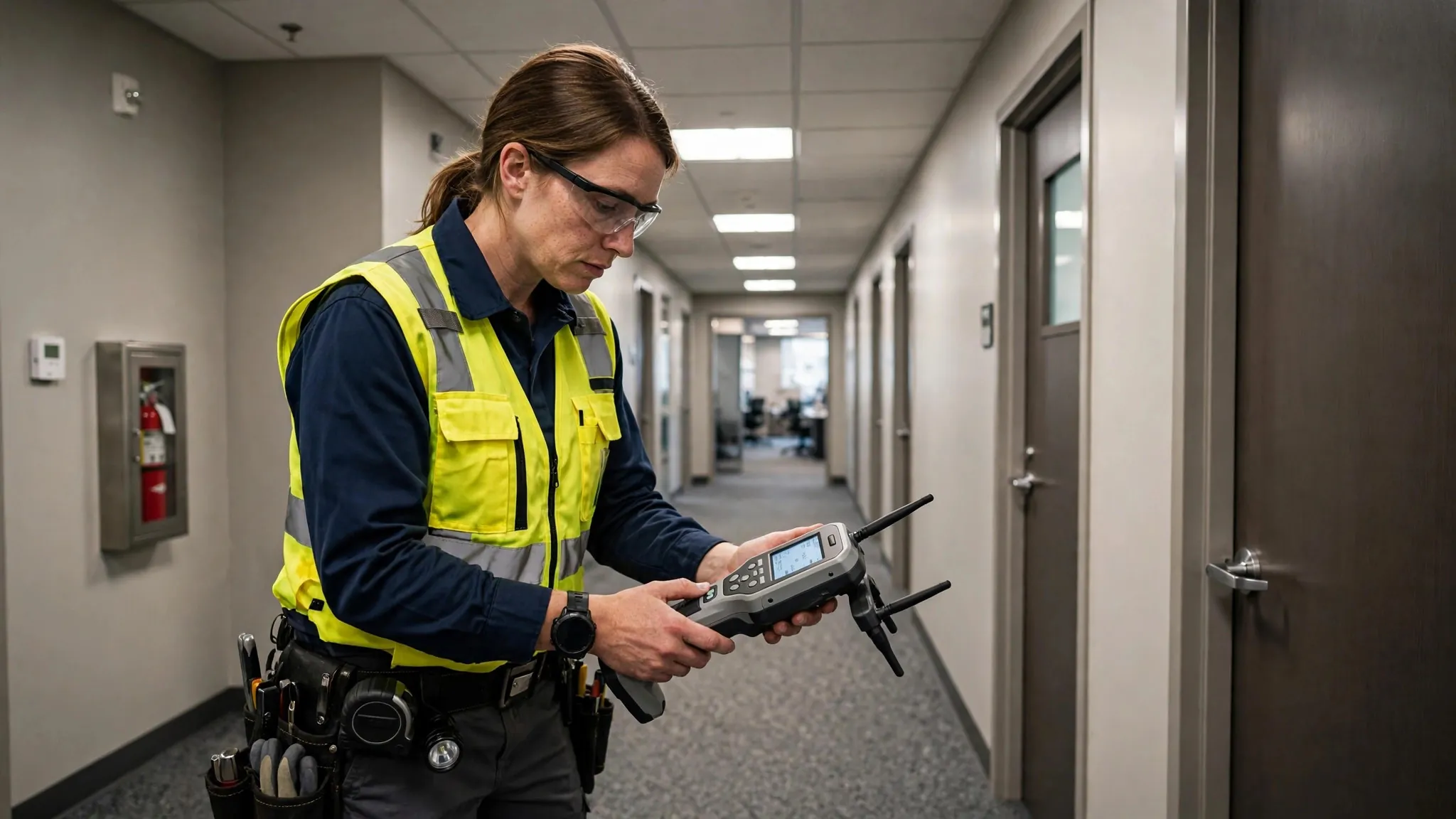
When backups recur or affect multiple drains, camera inspection is non-negotiable — it is the only way to see roots, bellies, collapses, offsets, and scale directly. The camera determines:
- What the obstruction is (roots vs. grease vs. debris vs. structural).
- Where it is (exact location and depth for targeted repair).
- Whether clearing suffices or structural repair is needed.
Structural findings (collapse, severe belly, major root intrusion) require repair or replacement — spot repair, lining, or full replacement depending on extent. Clearing a collapsed pipe is futile; the camera prevents that futility.
Lift Station Failures
Lift stations pump wastewater from below-grade spaces to the sewer. Failures — pump burnout, float switch malfunction, electrical issues, or overwhelmed capacity — back up every drain they serve, rapidly. Signs: multiple low drains backing up simultaneously, pump alarms (if equipped), no pump sounds during expected cycles.
Lift station failure is urgent — wastewater has nowhere to go, and backups escalate quickly. Emergency service for active multi-drain backups.
How Professionals Fix Commercial Drain Backups
- Assessment: backup pattern analysis; single vs. multiple drains; history.
- Camera inspection: visual diagnosis of the line's interior — the definitive step.
- Clearing: mechanical augering, hydro jetting (for grease and scale), or root cutting — matched to the obstruction.
- Structural repair (if indicated): spot repair, lining, or replacement at the camera-marked location.
- Verification: post-repair camera run confirming clear flow.
- Prevention plan: maintenance schedule matched to the cause (grease trap servicing, root treatment, etc.).
Prevention By Cause
- Grease: properly sized traps, scheduled cleaning, staff training, no grease down drains.
- Debris: drain screens, sediment traps, regular floor-drain maintenance.
- Roots: periodic root treatment, camera monitoring of vulnerable lines, consider replacement of root-prone sections.
- Structural: camera baseline for aging lines; plan replacement before failure.
- Lift stations: pump maintenance schedules, alarm systems, backup pump considerations.
Camera Inspection: What It Reveals
A sewer camera inspection — a waterproof camera on a flexible cable pushed through the drain line — is the definitive diagnostic for recurring or multi-drain backups. It reveals:
- Root intrusion: visible root masses at joints; severity graded by blockage percentage.
- Bellies: sagging sections holding standing water; measured by depth and length.
- Collapses and breaks: structural failures; located precisely for repair.
- Offset joints: separated pipe segments; often from ground movement.
- Grease and scale: buildup thickness and extent; guides cleaning method.
- Foreign objects: construction debris, collapsed liners, lost tools.
The camera provides location (distance from access) and depth — the two coordinates for targeted repair. Always request the video file — it is your record for second opinions, insurance, and capital planning.
Hydro Jetting: When And How
Hydro jetting — high-pressure water (typically 3,000-4,000 PSI) scouring pipe interiors — is the professional standard for grease, scale, and debris:
- Effective for: grease buildup, mineral scale, sludge, and soft blockages.
- Not for: structural failures (collapse, severe offsets) — jetting cannot fix structure and may worsen it.
- Requires: camera inspection first (to rule out structural issues) and downstream access.
- Maintenance role: scheduled jetting prevents grease and scale accumulation in high-risk lines.
Camera Before Jetting
Jetting a structurally compromised line can turn a repairable belly into a collapse. The camera inspection is not optional preparation — it is the safety check that determines whether jetting is appropriate at all.
Trenchless Repair Options
| Method | What It Does | Best For |
|---|---|---|
| Cured-in-place pipe (CIPP) lining | New pipe inside the old | Cracked or root-damaged lines with intact shape |
| Pipe bursting | Replace by fracturing old pipe outward | Collapsed or undersized lines needing full replacement |
| Spot repair | Excavate and replace one section | Single localized failure |
| Full excavation | Replace the entire run | Extensive failure; regrading needed |
Trenchless methods minimize disruption — critical for commercial properties where excavation disrupts operations. The camera inspection determines candidacy.
Building A Drain Maintenance Plan
- Baseline camera inspection — know your lines' current condition.
- Risk classification — grease-prone (kitchens), root-prone (near trees), age-prone (old pipe).
- Scheduled maintenance — jetting intervals, grease trap servicing, root treatment matched to risk.
- Monitoring — log every backup (date, location, resolution); patterns trigger inspection.
- Capital planning — aging lines get replacement budgets before emergency failures.
For lift station maintenance and main-line diagnosis, see our companion guides.
Drain History: The Log That Predicts
Maintain a drain incident log — the pattern predicts the future:
| Log Entry | What To Record | Pattern It Reveals |
|---|---|---|
| Date and time | When the backup occurred | Seasonal or usage correlations |
| Location | Which drain(s) | Single-point vs. systemic issues |
| Severity | Slow drain vs. full backup | Progression over time |
| Resolution | What fixed it (and what did not) | Recurrence despite clearing = structural |
| Conditions | Weather, usage, recent changes | Contributing factors |
Three entries for the same drain trigger camera inspection — the log makes the decision objective, not debatable.
Tenant Education For Drain Health
- What not to put down drains — grease, wipes, sanitary products, and debris (post in kitchens and restrooms).
- Report early — slow drains reported promptly prevent full backups.
- Grease discipline — scrape plates before washing; the trap is the last defense, not the first.
For commercial leak protection and lift station care, see our companion guides.
Emergency Drain Response Checklist
- Stop water use in the affected area — every flush and drain adds to the backup.
- Identify the scope — single drain or multiple? The answer determines urgency.
- Check for sewage — odor and discoloration indicate a health hazard; restrict access.
- Call for service — professional for multi-drain or sewage; assess single-drain for DIY clearing.
- Document — photos and notes for the incident log and potential insurance.
- Do not use chemical cleaners — they complicate professional service and rarely resolve commercial blockages.
Post this checklist where maintenance staff can find it — the first responder's actions in the first 15 minutes significantly affect the outcome.