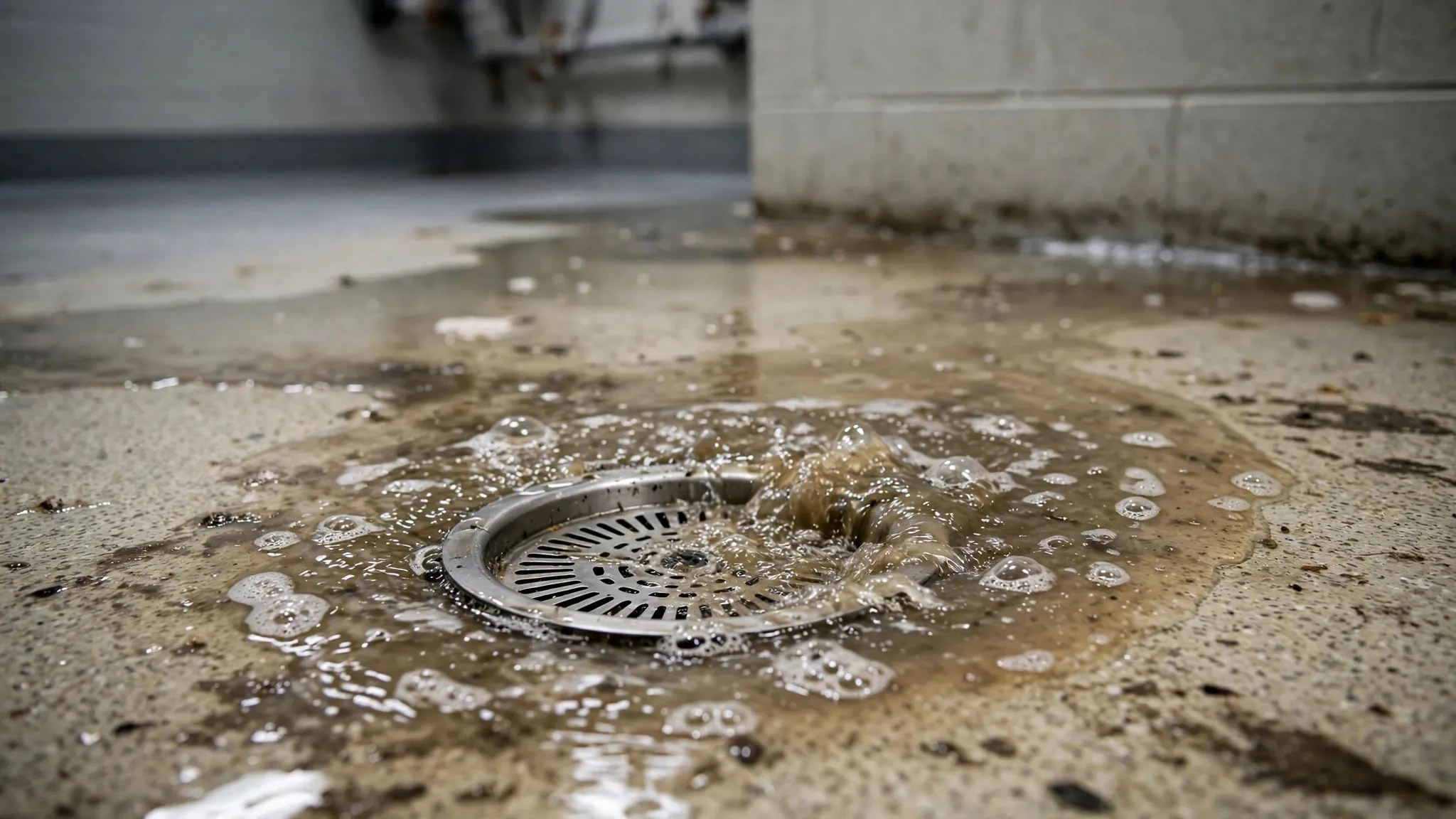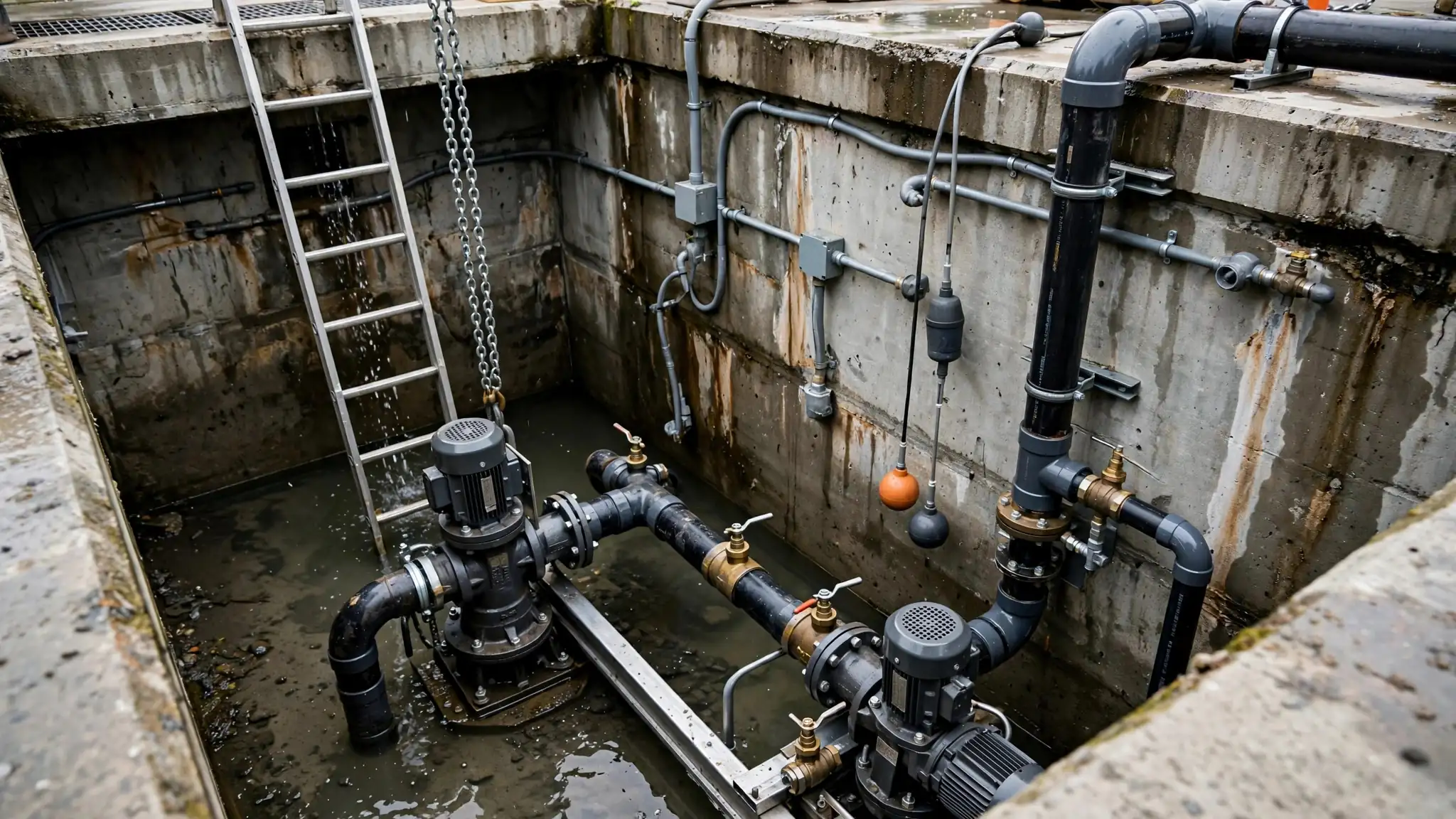
A lift station pump moves wastewater from below-grade spaces up to the sewer line — anywhere gravity drainage is impossible: basements, underground parking, below-street commercial spaces. The system: a collection basin (wastewater flows in by gravity), a pump (activates via float switch at a set level), and a discharge line (carries wastewater up to the sewer). When it works, it is invisible. When it fails — pump burnout, float malfunction, electrical failure, or capacity overload — wastewater has nowhere to go, and every drain it serves backs up, rapidly. Professional lift station service covers diagnosis, repair, and preventive maintenance.
Quick Answer
A lift station pump lifts wastewater from below sewer level (basements, underground spaces) up to the gravity sewer via a basin, pump, float switch, and discharge line. It fails from pump wear/burnout, float switch malfunction, electrical issues, clogged impellers (wipes, grease, debris), and capacity overload. Failure backs up all served drains quickly — it is urgent. Prevention: regular maintenance, alarms, and keeping non-flushables out of the system.
How Lift Stations Work
Gravity moves wastewater downhill — but below-grade spaces sit below the sewer line. The lift station bridges this gap:
- Collection: wastewater from below-grade fixtures flows by gravity into the basin (a sealed pit).
- Activation: rising water lifts the float switch; at the set level, it activates the pump.
- Discharge: the pump forces wastewater up through the discharge line to the gravity sewer.
- Cycle complete: the level drops, the float deactivates the pump, and the basin refills for the next cycle.
Larger stations use duplex pumps (alternating for even wear, with the second as backup) and alarm systems (high-water alerts). The principle is identical at every scale.
The Components And Their Roles
| Component | Function | Failure Mode |
|---|---|---|
| Basin | Collects wastewater | Cracks, infiltration, undersizing |
| Pump | Lifts wastewater to sewer | Burnout, impeller clog, seal failure |
| Float switch | Activates pump at set level | Sticking, tangling, electrical failure |
| Discharge line | Carries wastewater up | Blockage, check-valve failure |
| Check valve | Prevents backflow into basin | Sticking open (cycling) or closed (no discharge) |
| Alarm | Alerts on high water/failure | Disabled, unmonitored, or absent |
| Control panel | Manages pump operation | Electrical faults, settings drift |
Why Lift Station Pumps Fail: The 6 Causes
1. Pump Burnout And Wear
Pumps are mechanical — bearings wear, seals fail, motors burn out. Age, excessive cycling (from undersizing or check-valve issues), and running dry accelerate failure. Duplex systems extend life through alternation; simplex systems have no redundancy.
2. Float Switch Malfunction
The float is the system's brain — and a common failure point. Floats stick (debris, grease), tangle (on basin features), or fail electrically. A stuck-down float never activates the pump (backup); a stuck-up float runs the pump dry (burnout).
3. Clogged Impellers
"Flushable" wipes (not actually flushable), grease, feminine products, and debris wrap impellers and clog pump intakes. The leading preventable cause — and entirely a user-behavior issue.
4. Electrical Failures
Tripped breakers, failed capacitors, control panel faults, and power outages stop the system regardless of mechanical condition. No backup power = no pumping during outages — a critical vulnerability.
5. Check Valve Failure
A failed-open check valve lets discharged wastewater flow back into the basin — the pump cycles endlessly without lowering the level (rapid wear, eventual burnout). A failed-closed valve blocks discharge entirely.
6. Capacity Overload
Undersized stations, increased usage, or stormwater infiltration overwhelm pump capacity — the basin fills faster than the pump empties it. Design flaw or changed conditions; the fix is capacity, not just repair.
Wipes Are The Enemy
So-called 'flushable' wipes are the leading preventable cause of lift station failures — they do not disintegrate and they destroy pumps. Signage, education, and enforcement (in commercial settings) are the prevention. This single behavior change prevents more failures than any maintenance schedule.
Warning Signs Of Impending Failure
- Frequent cycling — pump running constantly or in rapid cycles (check-valve or float issue).
- Unusual noises — grinding, rattling (impeller obstruction or bearing wear).
- Slow drainage from served fixtures — the station not keeping up.
- Alarm activations — high-water alerts (never ignore; investigate every one).
- Odors — sewage odors near the basin indicate ventilation or seal issues.
- Visible basin level — water persistently high means the pump is not discharging adequately.
When Lift Station Failure Is Urgent
- Multiple drains backing up — the station is not discharging; wastewater is rising.
- Alarm sounding with no pump operation — total failure; backup imminent or occurring.
- Sewage surfacing — health hazard; restrict access and call immediately.
Lift station emergencies escalate fast — wastewater accumulates with every flush and every drain use. Emergency service for active failures.
Preventive Maintenance: The Schedule
| Task | Frequency | Why |
|---|---|---|
| Visual inspection (basin, floats, alarms) | Monthly | Catch sticking floats and alarm issues early |
| Pump operation test | Quarterly | Verify activation levels and discharge |
| Basin cleaning (grease, debris removal) | Semi-annually | Prevent impeller clogs and float interference |
| Electrical and control check | Annually | Catch panel and wiring issues |
| Full professional service | Annually | Comprehensive assessment and preventive replacement |
| Alarm system test | Quarterly | Ensure alerts actually alert |
Additionally: backup power (generator or battery) for critical stations; redundant pumps (duplex) for high-consequence installations; and user education (what not to flush) as the cheapest prevention available.
Professional Lift Station Service
Professional service covers diagnosis (which component failed and why), repair (pump replacement, float service, electrical, check valves), capacity assessment (is the station adequate for the load?), and preventive maintenance contracts (scheduled service preventing emergency failures). For drain backup diagnosis and commercial leak protection, see our companion guides.
Sizing And Capacity: Getting It Right
Lift station sizing — basin volume and pump capacity matched to inflow — determines reliability:
- Undersized basin: rapid cycling (pump starts/stops constantly) — accelerates wear dramatically.
- Undersized pump: cannot keep up with peak inflow — chronic high water, eventual backup.
- Oversized: less problematic, but excessive cycling can still occur with poor float settings.
- Assessment: compare pump discharge rate against measured peak inflow; review cycle frequency logs.
Stations installed during original construction may be undersized for current use — added fixtures, increased occupancy, or changed operations outgrow the original design. Reassess after any significant building change.
Backup Power: The Non-Negotiable
Power outages do not pause wastewater generation — but they do pause pumping. Backup power options:
| Option | Coverage | Considerations |
|---|---|---|
| Battery backup (UPS) | Short outages (hours) | Maintenance of batteries; limited duration |
| Portable generator | Extended outages | Manual deployment; fuel; transfer switch needed |
| Standby generator | Automatic, extended | Higher cost; automatic transfer; fuel supply |
| Duplex pump + alarm | Not power backup — mechanical redundancy | Complements, does not replace, power backup |
For any station where backup has significant consequences (which is most commercial installations), backup power is infrastructure, not accessory.
Test Backup Power Under Load
A generator that has never run under actual pump load is a hope, not a plan. Test backup systems under real operating conditions on a schedule — monthly for critical stations. The outage is the wrong time to discover a dead battery.
Maintenance Contracts: What To Expect
- Scheduled visits — quarterly to annually depending on station criticality and loading.
- Scope: pump inspection and testing, float verification, basin cleaning, electrical checks, alarm testing, and condition reporting.
- Emergency response terms — defined response times for failures; after-hours coverage.
- Parts and replacement: clarify what is included vs. billed separately (pumps, floats, panels).
- Documentation: service reports for compliance, insurance, and capital planning.
When To Replace Vs. Repair
| Situation | Repair | Replace/Upgrade |
|---|---|---|
| Single component failure, station otherwise sound | Yes — targeted repair | — |
| Repeated pump failures | — | Yes — investigate sizing/systemic cause |
| Chronic undersizing | — | Yes — capacity upgrade |
| Aging station, multiple issues | — | Yes — comprehensive renewal |
| Code or compliance changes | — | Yes — upgrade to current standards |
For drain backup diagnosis and commercial leak protection, see our companion guides.
Troubleshooting Guide: Symptoms To Causes
| Symptom | Most Likely Cause | Check First |
|---|---|---|
| Pump never runs; basin overflows | Float stuck down or electrical failure | Float freedom of movement; breaker |
| Pump runs constantly | Check valve failed open or float stuck up | Check valve function; float position |
| Pump runs but level does not drop | Discharge blockage or check valve closed | Discharge line; check valve |
| Grinding noises | Impeller obstruction | Power off; inspect impeller |
| Alarm with no obvious cause | High-water float or sensor issue | Alarm float; control panel |
| Intermittent operation | Loose wiring or failing float switch | Electrical connections; float test |
Electrical Safety
Lift station troubleshooting involves water and electricity in proximity — a hazardous combination. De-energize before physical inspection; electrical diagnosis belongs to qualified personnel. No maintenance task is worth an electrical injury.
When To Upgrade The Entire Station
- Capacity exceeded — the building outgrew the station; larger basin and pumps needed.
- Chronic failures — the station fails more often than it runs reliably; systemic renewal beats perpetual repair.
- Code compliance — regulations evolved; the station must meet current standards.
- Technology upgrade — smart monitoring, duplex redundancy, and modern controls justify renewal.
For drain backup response and commercial protection, see our companion guides.