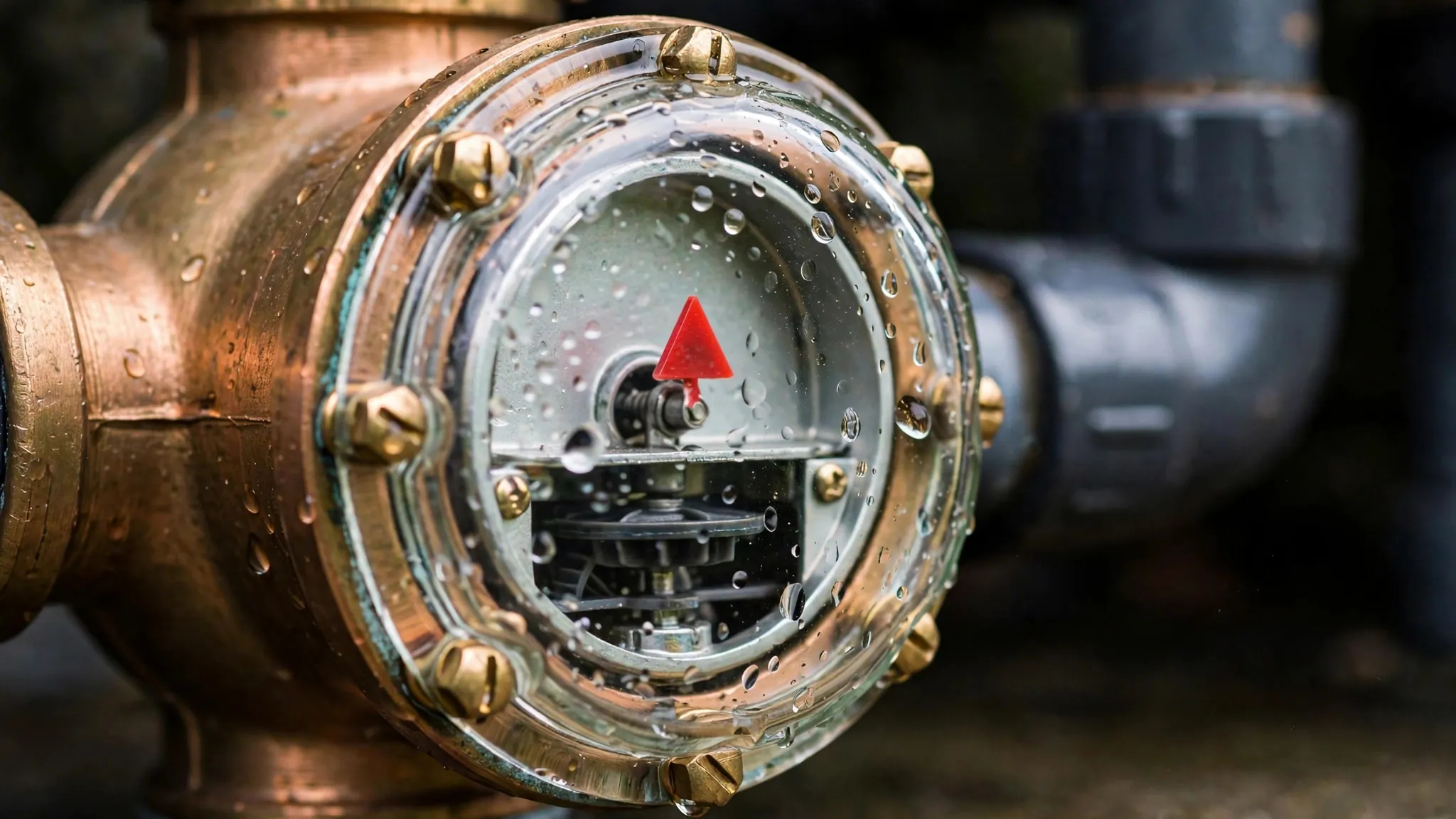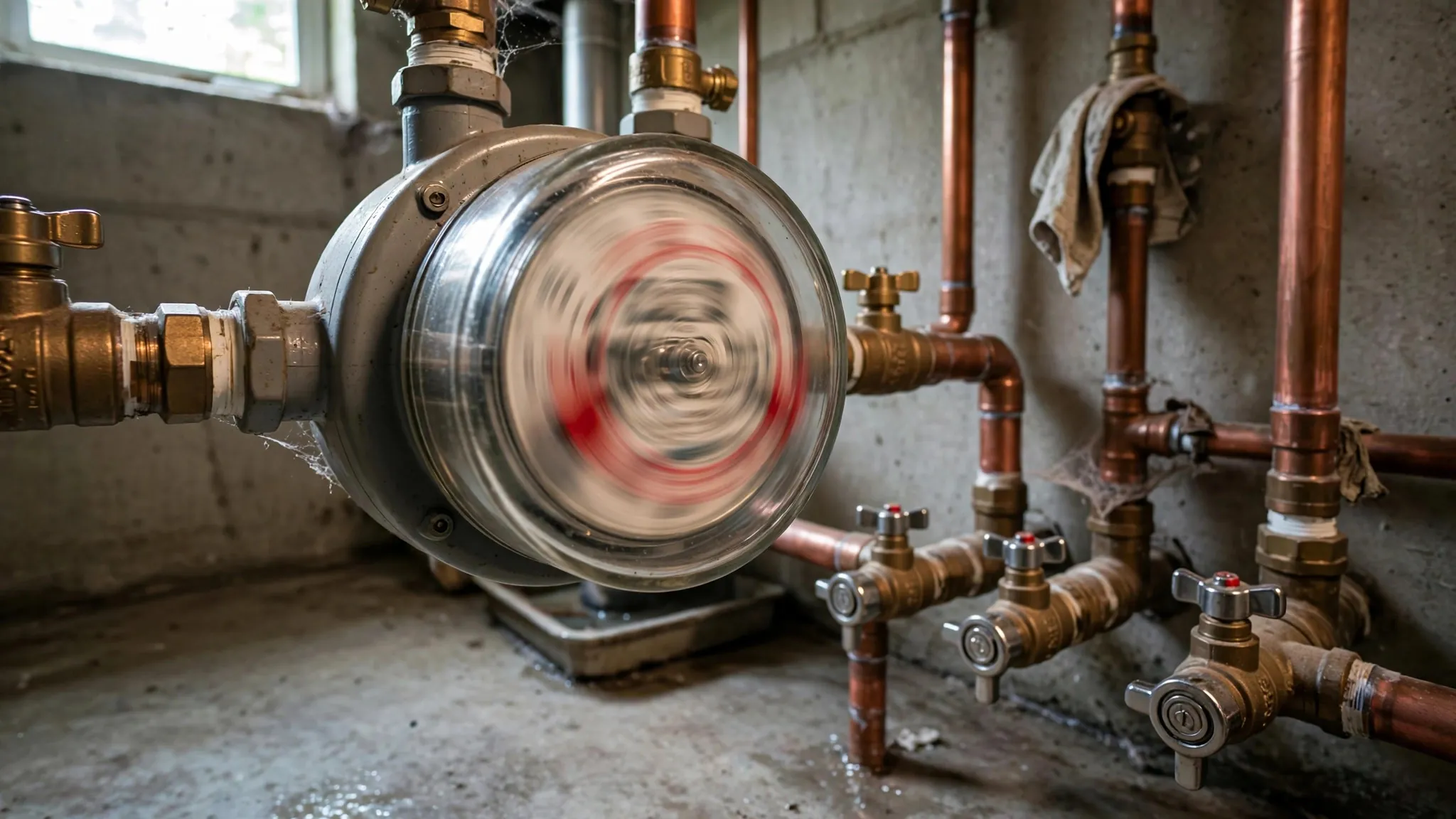
Your water meter measures every gallon entering your home — and its flow indicator (a small triangle, star, or dial) reveals hidden flow instantly: if it moves with everything off, water is escaping somewhere. Reading the meter means understanding three elements: the odometer-style register (total gallons used), the sweep hand or dial (current flow rate), and the leak/flow indicator (the most sensitive leak signal). This guide teaches all three — the foundation skill behind the 2-hour meter test and every high-bill investigation.
Quick Answer
Find your meter (usually in a ground-level box near the curb), lift the lid, and look for the flow indicator — a small triangle or star. With all water off inside and out, any movement means a leak. The odometer register shows total usage for before/after comparisons; the sweep hand shows real-time flow. Record the reading, wait, and re-read: movement over time quantifies the leak.
Finding Your Water Meter
Residential meters typically sit in a ground-level box near the curb or property line — a rectangular concrete or plastic lid, sometimes marked "water" or "meter." Lift the lid (a screwdriver helps with snug lids); the meter itself is a brass or plastic unit with a dial face, sometimes under a protective cover you flip open. In cold climates, meters may be indoors — basement or utility room, where the service line enters.
Safety: meter boxes can house insects, and lids are heavy — lift carefully. Note the box's condition while you are there: standing water in the meter box is itself a leak symptom worth investigating.
The Three Parts That Matter
- The register (odometer): a row of numbers showing total water used — your before/after comparison tool. Note whether your utility bills in gallons or cubic feet; the register face usually states the unit.
- The sweep hand or flow dial: a rotating hand or dial showing real-time flow — useful for watching flow start and stop as fixtures cycle.
- The leak/flow indicator: a small triangle, star, asterisk, or gear — the most sensitive element. It moves with even tiny flows that the sweep hand barely registers. This is your primary leak signal.
The Indicator Is The Instrument
Ignore the big numbers for leak detection — watch the small flow indicator. It is engineered to reveal the tiny continuous flows that characterize hidden leaks: a slowly spinning triangle with everything off is the classic positive result.
Reading The Flow Indicator
With every water-using fixture and appliance off — toilets not refilling, ice maker idle, irrigation off, nobody running taps — watch the indicator for 60 seconds:
- Completely still: no hidden flow at this moment. (Intermittent leaks, like a softener regeneration, may still exist — test at another time.)
- Slow, steady creep: a small continuous leak — think toilet flapper, dripping supply, or pinhole.
- Steady spinning: a significant continuous leak — pressurized break territory. Here is what to do next.
Make sure "everything off" is truly everything: ice makers, water softeners, humidifiers, and irrigation controllers are the classic forgotten consumers that produce false positives.
Reading The Register For Quantification
The register lets you measure the leak, not just detect it. Record the full odometer reading, wait a known period with no water use (the 2-hour test is standard), and re-read. The difference, divided by the time, is your leak rate in gallons per hour — the number that tells you whether you are chasing a toilet flapper or a slab break, and the number your utility needs for billing adjustments.
The 5-Minute Leak Check
- Turn off every fixture, appliance, and irrigation zone. Verify toilets have finished refilling.
- Open the meter box and locate the flow indicator.
- Watch for 60 seconds. Any movement = hidden flow.
- If moving, record the register reading and the time.
- For quantification, run the full 2-hour meter test.
Practical Tips
- Photograph the register at each reading — timestamps eliminate disputes and memory errors.
- Test at night when household water use is naturally zero — fewer false positives.
- Know your units — gallons vs. cubic feet matters when comparing against your bill.
- A still meter does not clear intermittent causes — softeners, irrigation valves, and T&P discharges can leak on schedules; test more than once if the bill says otherwise.
Meter reading is the foundation of every high-bill leak investigation — master it, and you will never again wonder whether a bill spike is real.
Common Meter Types
Residential meters vary, but all share the readable elements:
- Analog dial meters: the classic — odometer register, sweep hand, and flow indicator triangle. Read left to right like a car odometer.
- Digital/smart meters: LCD display cycling through readings — total usage, flow rate, and sometimes leak alerts. Note which screen shows what; the manual (or utility website) decodes the display codes.
- Remote-read meters: analog face plus a transmitter — read the face directly; the transmitter is the utility's concern.
Smart meter leak alerts deserve attention but not blind trust — they flag continuous flow, which includes legitimate patterns (softener regeneration, irrigation). Verify with your own indicator watch before concluding.
Gallons, Cubic Feet, And Your Bill
Utilities bill in gallons or hundred cubic feet (CCF) — 1 CCF ≈ 748 gallons. The meter face states its unit; your bill states its unit. When they differ, convert before comparing: a "small" CCF number represents hundreds of gallons. Misreading units is a surprisingly common source of phantom bill panic — and phantom complacency.
Keeping A Meter Log
A simple ongoing log — date, time, reading, notes — transforms the meter from emergency tool to early-warning system:
- Weekly readings establish your household's normal baseline across seasons.
- Deviations from baseline trigger investigation before the bill arrives.
- Pre/post vacation readings catch leaks that ran while you were away.
- Pre/post repair readings verify the fix worked.
The Two-Minute Habit
Glance at the flow indicator whenever you happen to be near the meter box — it takes seconds and builds the familiarity that makes anomalies obvious. The best leak detector is a homeowner who knows their meter.
When The Meter Is Hard To Read
- Fogged dial: condensation inside the lens — note it to the utility; meanwhile, the flow indicator is often still visible.
- Buried or overgrown box: clear access matters in emergencies — keep the box locatable and the lid liftable.
- Standing water in the box: bail carefully to read, but treat the water itself as a symptom (meter-box leak signs).
- Inaccessible meter: ask the utility for access options — you have a legitimate interest in reading your own meter.
A Brief History Of Water Metering
Water meters evolved from positive-displacement mechanisms (water physically turning a measuring chamber — accurate but wear-prone) to modern ultrasonic and electromagnetic smart meters (no moving parts, continuous data). The progression matters because newer meters detect smaller flows more reliably — a smart meter's leak alert catches what an old displacement meter's sticky indicator might miss. If your meter is decades old, its sensitivity is a legitimate question to raise with your utility.
Commercial And Multi-Unit Meters
Larger buildings use compound or turbine meters sized for higher flows — their indicators are less sensitive to small leaks relative to total capacity. For multi-unit buildings, submetering (individual unit meters) transforms leak detection from building-wide to unit-specific. Property managers: a building-wide meter test that shows flow, followed by unit-by-unit isolation, is the systematic path — and submeters make it dramatically faster.
Bigger Meter, Bigger Blind Spot
Large commercial meters can miss small leaks that would spin a residential indicator visibly. Multi-unit and commercial properties need proportionally more vigilant monitoring — the meter's sensitivity scales inversely with its size.
For Tenants: Meter Access Rights
Tenants have legitimate interests in meter readings — unusual bills, suspected leaks, and submeter disputes all warrant access. Most leases and local regulations support reasonable access; where meters serve multiple units, the landlord or manager typically performs readings on request. Document requests in writing. If a suspected leak affects your unit, the meter test procedure works the same — coordinate the zero-use window with the property manager.
Using Readings In Billing Disputes
Meter readings are evidence. In disputes:
- Timestamped photos beat verbal claims — photograph every reading.
- Consistent methodology (same time of day, same conditions) strengthens the record.
- Utility data requests — ask for their reading history to compare against yours.
- Professional corroboration — a detection report with measured flow rate is authoritative.
Utilities and courts respect documented data; they discount remembered impressions. The habit of photographing readings pays off precisely when it matters.
Mastering your water meter is a foundational homeowner skill — the equivalent of knowing where your electrical panel is. It costs nothing, takes minutes to learn, and pays dividends every time a bill looks wrong or a leak is suspected. Pair meter literacy with the 2-hour test procedure and you hold the complete DIY leak-detection toolkit.