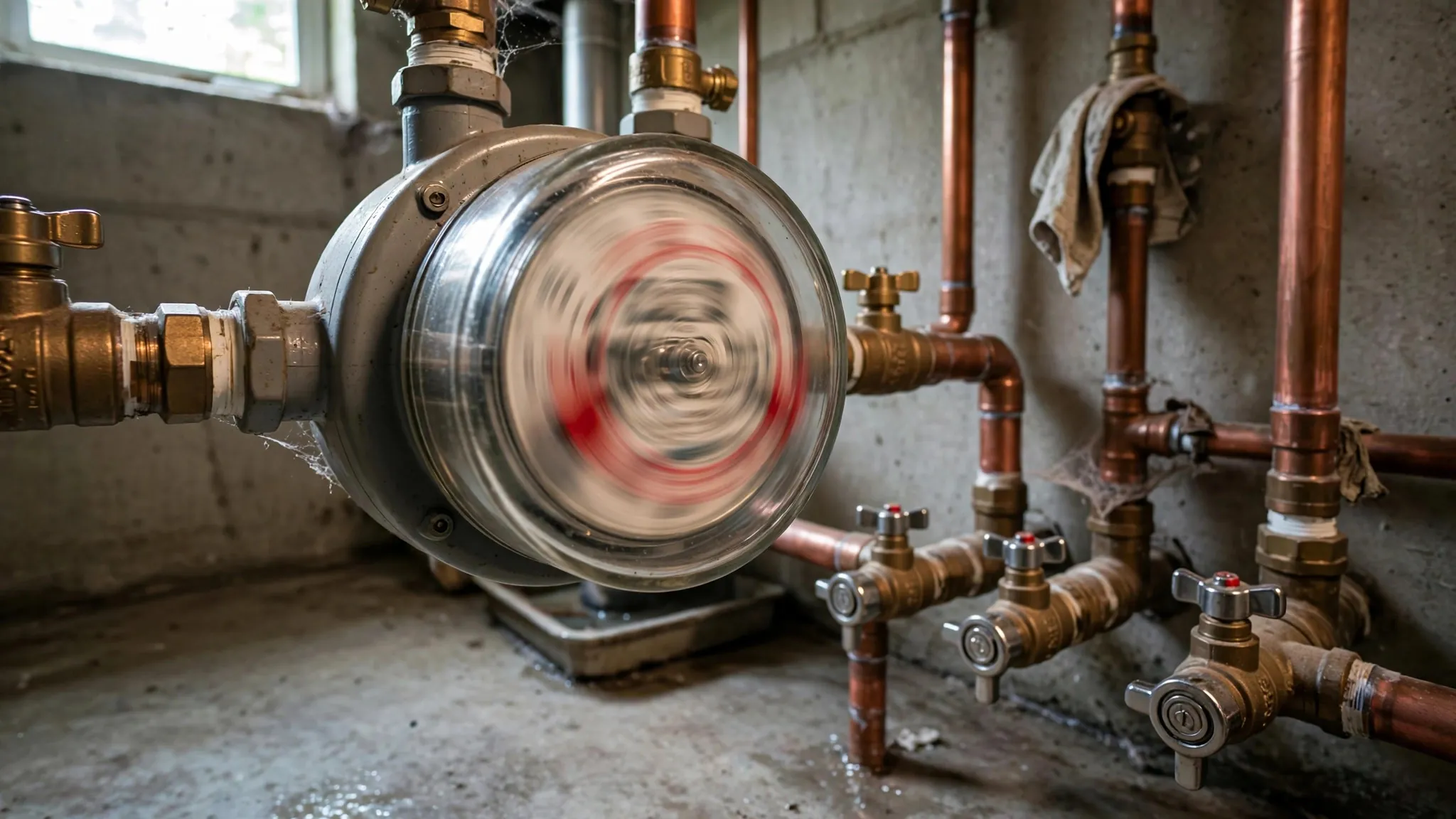
A water meter that keeps spinning with everything off means water is flowing continuously somewhere in your system — this is not a billing error or a slow drip; it is an active, pressurized leak. Your immediate steps: verify true zero use (ice makers, softeners, irrigation off), assess the spin rate (slow creep vs. rapid spin indicates severity), isolate by zone (shut fixture valves one at a time), and scan for damage symptoms (warm floors, sounds, soggy ground, water where it should not be). Rapid spinning with any property symptom is urgent — emergency response is available 24/7.
Quick Answer
A continuously spinning meter means continuous hidden flow — verify every automatic device is truly off, then gauge severity by spin rate: slow creep suggests a toilet or small leak; rapid spinning suggests a pressurized break. Isolate toilets and irrigation first; if spinning continues, check for slab-leak and underground-leak symptoms. Rapid spin plus any damage sign warrants an immediate professional call.
What A Spinning Meter Means
The meter's flow indicator responds to actual water movement through the service line. With every fixture, appliance, and irrigation zone verifiably off, sustained movement has exactly one explanation: water is escaping the system somewhere between the meter and your fixtures — a leak, not a malfunction. (Meter malfunctions that over-register are rare; hidden flow is common. Trust the physics.)
The critical distinction is rate: a slow, lazy creep and a vigorous spin describe very different problems, as the next section explains.
What To Do Right Now
- Confirm true zero use. Ice maker off, softener regeneration postponed, irrigation controller off, humidifiers off, all toilets idle and silent. Re-check the meter.
- Gauge the spin rate. Slow creep vs. steady spin vs. rapid spinning — this determines urgency (see below).
- Isolate toilets. Shut each toilet's supply valve, watching the indicator after each. If it stops, you found it.
- Isolate irrigation. Shut the irrigation main or backflow valve; re-check.
- Scan for damage. Warm floors, running-water sounds, soggy yard, water in the meter box, damp walls — any of these plus a spinning meter is urgent.
- Call. Spinning continues with zones isolated, or any damage symptom present: professional detection — or emergency service if severe.
Need Help Right Now?
Meter spinning rapidly, or spinning with warm floors, sounds, or soggy ground? That is an active pressurized break — call now, 24/7.
Call (617) 380-4912Reading The Severity From The Spin Rate
| Spin Behavior | Likely Meaning | Urgency |
|---|---|---|
| Slow, intermittent creep | Toilet flapper, dripping fixture, or weeping valve | Fix soon — bill impact, minor damage risk |
| Steady, continuous rotation | Running toilet, stuck valve, or moderate pressurized leak | Investigate today — meaningful water loss |
| Rapid spinning | Major pressurized break — slab, buried line, or burst pipe | Urgent — potential property damage underway |
For quantification, run the 2-hour test: the gallons-per-hour rate converts spin impression into hard numbers for decision-making and billing disputes.
Isolating The Source Zone
Systematic isolation turns "somewhere" into a zone:
- Toilets: shut each supply valve individually, watching the indicator for 60 seconds after each. The valve that stops the spin identifies the culprit.
- Irrigation: close the irrigation shutoff; a stopping indicator points to a broken lateral or stuck valve.
- Water heater: close the cold-water inlet to the heater; if spinning stops, the leak is on the hot-water side (including hot-water slab lines).
- Whole-house: close the main house shutoff (leaving the meter pressurized). If the indicator stops, the leak is inside the house plumbing. If it continues, the leak is in the service line between meter and house — meter-box/service-line territory.
The Main-Shutoff Test
The whole-house shutoff test is the single most informative isolation step: it divides the entire system into 'house side' vs. 'service line side' in one move. Know where your main shutoff is before you need it — usually near where the service line enters the house.
Damage Symptoms To Check While You Investigate
- Warm floor patches — hot-water slab break (warm spot guide).
- Running-water sounds with everything off (phantom sounds guide).
- Soggy yard strips or lush patches (underground signs).
- Water in the meter box (meter-box guide).
- Damp walls, ceilings, or flooring — active interior damage.
Any of these alongside a spinning meter elevates the situation from "investigate" to "act now."
What Happens If You Wait
- Continuous billing. A spinning meter is a running cash register — every hour adds gallons you will pay for.
- Escalating damage. Pressurized breaks erode soil, saturate structures, and grow; the break does not stabilize.
- Secondary failures. Eroded soil undermines slabs; saturated materials grow mold; water finds electrical systems.
DIY Vs Professional
| Situation | Safe DIY | Call A Professional |
|---|---|---|
| Slow creep, no symptoms | Dye-test toilets; fix drips; monitor | If creep persists after fixture fixes |
| Steady spin, isolated to a zone | Shut the zone's valve to stop loss | To find and repair the break in that zone |
| Rapid spin | Shut the main if damage is visible; photograph | Immediately — emergency service 24/7 |
| Spin continues with main shut | Note it — service-line leak confirmed | Service-line detection needed |
How Professionals Handle A Spinning Meter
A professional investigation starts where your isolation ended: confirming flow rate, completing zone isolation with professional valves, then deploying acoustic listening (for pressurized breaks), thermal imaging (hot-water lines), and tracer gas (pinpoint confirmation). The deliverable is a located break plus a measured flow rate — the documentation your utility and insurer need. When the spin is rapid or damage is visible, our emergency team responds 24/7 with the same equipment.
Documenting For Billing Disputes And Insurance
A spinning meter is the beginning of a paper trail. Build it from the first observation:
- Timestamped meter photos — the spinning indicator (video is even better), plus register readings.
- Isolation log — which valves you closed, when, and what the indicator did.
- Symptom photos — any damage, sogginess, warmth, or water where it should not be.
- Professional report — the detection report with measured flow rate is the authoritative document.
- Repair receipts — dated, itemized, from licensed contractors.
This package supports utility leak adjustments (many utilities credit documented leaks), insurance claims (for resulting damage), and contractor accountability (the report defines the scope). Documentation made during the event beats reconstruction after it.
The Overnight Monitoring Protocol
When the spin is slow and no damage is visible, overnight monitoring is reasonable:
- Evening: photograph the register; ensure zero-use conditions; note the time.
- Morning: re-photograph before anyone uses water; compute the overnight rate.
- Compare: a stable rate suggests a constant leak (toilet, pinhole); a varying rate suggests intermittent causes.
- Decide: constant significant flow → schedule detection; growing rate or new symptoms → escalate to urgent.
Monitoring Is Not Waiting
Overnight monitoring is active investigation with a decision point at dawn — not indefinite delay. Set the decision criteria before the evening reading, and honor them in the morning.
Preventing The Next Spinning Meter
- Know your main shutoff location — the single most valuable emergency knowledge.
- Quarterly indicator glances — the two-minute habit that catches leaks early.
- Annual toilet dye tests — flappers are wear items; test on schedule.
- Pressure regulation — a PRV protects every pipe, joint, and valve in the system.
- Pre-vacation meter readings — catch what ran while you were away.
The Psychology Of The Spinning Meter
A spinning meter provokes a specific anxiety — money visibly draining with no off switch you can find. Acknowledge it, then channel it: the meter is actually your ally, providing the real-time data that makes diagnosis possible. Homeowners without meter access discover leaks via bills, weeks later and hundreds of dollars poorer. Your spinning meter is an early warning, not just a problem — it caught the leak in its cheapest phase. Work the protocol methodically; panic skips steps and misses zones.
Renters And Landlords: Who Acts
Plumbing leaks are the property owner's responsibility in virtually all leases — but the renter is often the first to notice. Renters: document (photos, dates), notify in writing immediately, and do not attempt repairs beyond shutting valves in emergencies. Landlords: a spinning meter with no tenant-caused explanation is a building-system issue — respond promptly, because the water bill and the damage accrue to you. Written notification starts the clock on reasonable response time.
Smart Meter Alerts: Trust But Verify
Where utilities have deployed smart meters, continuous-flow alerts may notify you before you ever look at the dial. Treat alerts as prompts to verify, not as diagnoses: confirm with a visual indicator check, rule out automatic devices, and run the 2-hour test for quantification. Smart alerts excel at catching leaks during absences (vacations, workdays) — the scenarios where manual checks never happen. If your utility offers alert enrollment, enroll; it is the closest thing to continuous monitoring currently widely available. Pair alerts with knowledge of hidden leak symptoms for complete coverage.